Ir al contenido

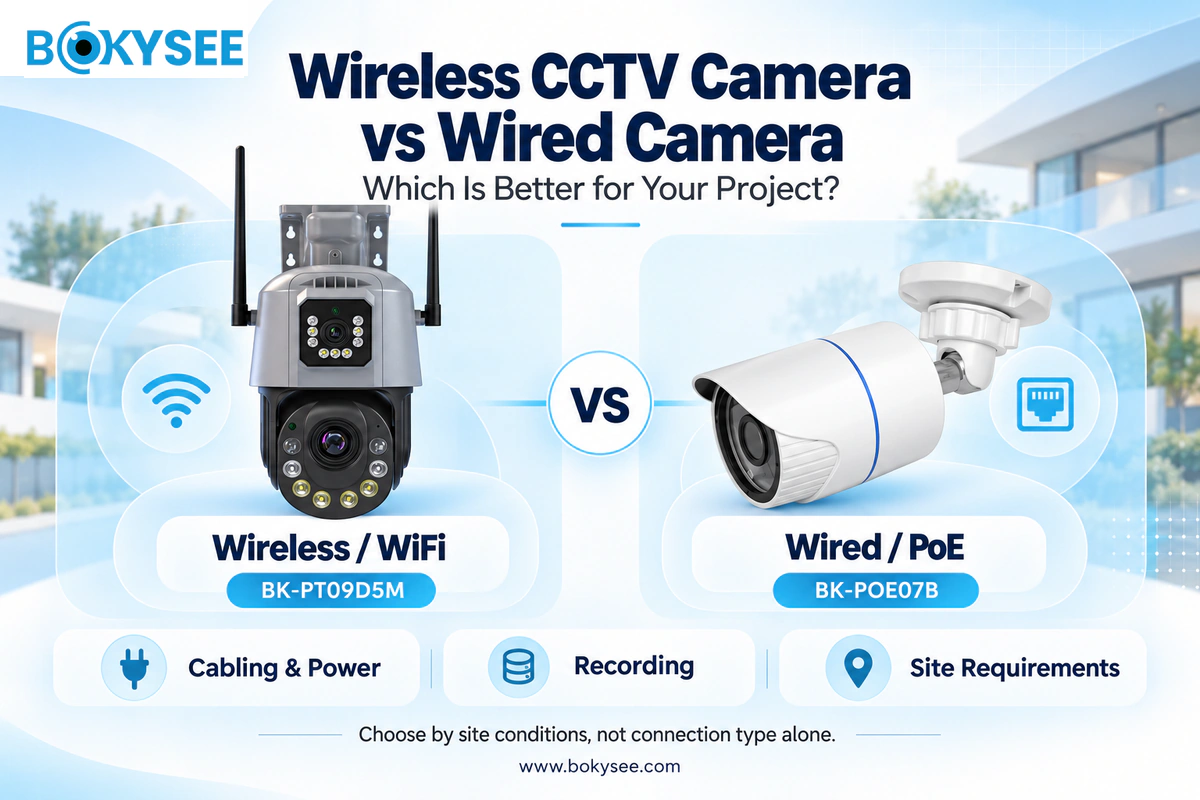
A sistema de cámaras de seguridad helps in keeping an eye on the entrances, securing the possessions, and reviewing the recordings in case of any event.
Selecting a wired vs wireless security cameras can be difficult due to the various factors. The factors include the size of the property, cost of installation, network connectivity, availability of power and maintenance in the future.
In this guide, we will inform the differences between wired and wireless surveillance cameras. We will inform consumers the difference between WiFi CCTV cameras, PoE cameras, and wireless camera system too. We will also inform about their installation needs, storage methods, outdoor capabilities, and buying tips of wired or wireless camera.
What is a Wired Security Camera?
Wired security cameras have a physical connection with a recorder or network or even with the power source. The way the camera is connected will depend on the kind of camera.
The connection of these cameras is different from that of wireless cameras in that the cameras need cables to communicate either with the network or to transmit their videos.
The cameras have stable connections and are used for uninterrupted monitoring in residential buildings, offices, and factories. People buying these systems will need to take into account the wiring needs.
How Wired CCTV Cameras Work?
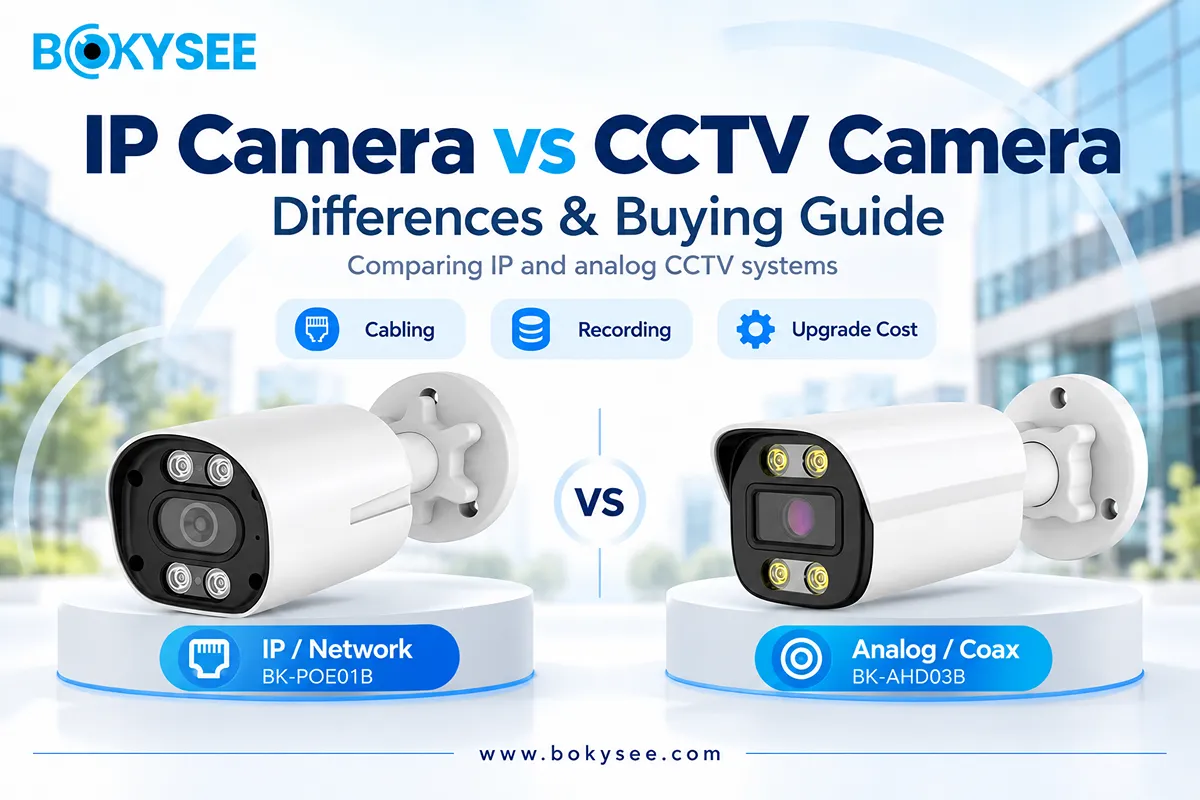
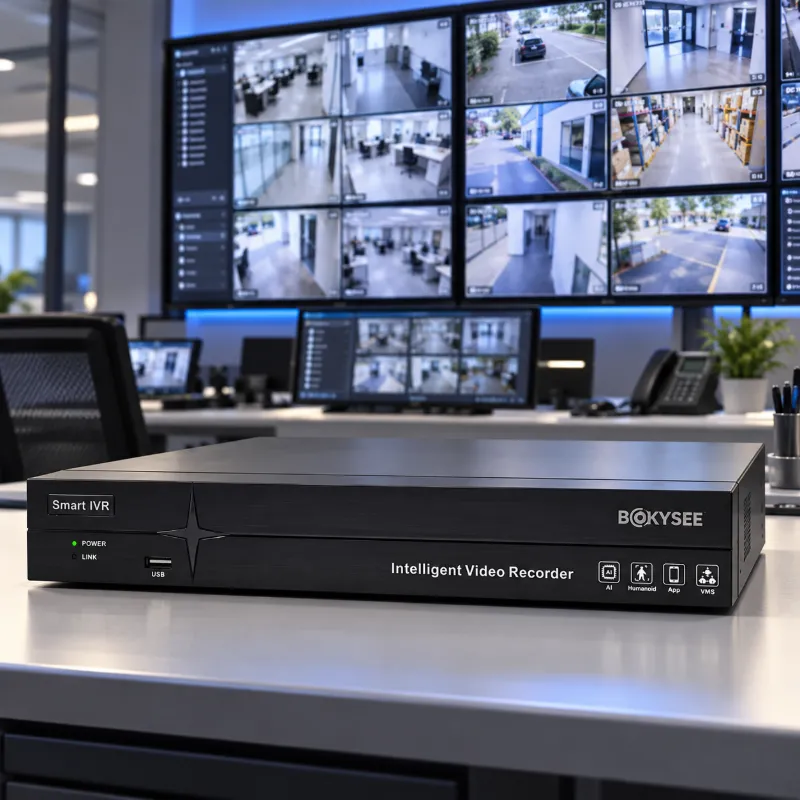
Wired CCTV cameras send their signal using coaxial and Ethernet cables. The conventional analog system utilizes Digital Video Recorder DVR in processing and storing video signals.
The modern IP camera system links with either Network Video Recorder NVR or the corresponding IP camera network system.
PoE technology allows transmission of both power and data signals using one Ethernet cable. This minimizes installation costs and simplifies the process. The wiring system depends on how the system is set up to provide for various functions.
Common Types Of Wired Security Cameras
There are several versions of wired security cameras that are suited to different surveillance needs.
● Analog HD Cameras: These cameras deliver analog video to the DVR system via an appropriate coaxial cable.
● IP Wired Cameras: These cameras provide digital video through the Ethernet network and connect to NVRs or another appropriate network infrastructure.
● PoE Cameras: These cameras deliver video and are powered by the same Ethernet cable through a suitable PoE switch or NVR. PoE camera.
● Commercial Wired Cameras: These cameras work with monitoring infrastructure in offices, manufacturing facilities, warehouses, and retail spaces.
● Before buying such devices, one should make sure of the compatibility of cameras, recorders, cabling, and network components.
What is a Wireless CCTV Camera?
In a wireless CCTV camera system, video data is transmitted using Wi-Fi or other wireless means instead of relying on separate video wires for every CCTV camera wireless .
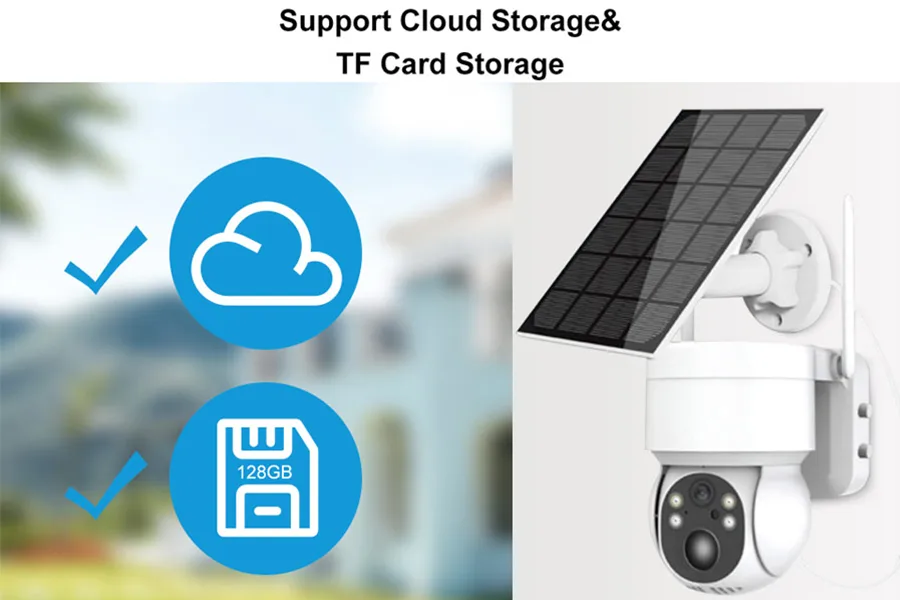
The device may be powered by either an electricity charger, rechargeable battery, or solar panel according to the specific model. The cameras can be installed in any convenient place and provide various means of storing the footage.
It is important to consider the wireless signal strength, power needs, and storage medium when purchasing a wireless CCTV camera system.
How Wireless Security Cameras Work?
The WiFi security cameras send video feed to either a WiFi-enabled router, recorder, cloud, or mobile application.
Once connected to the internet, one is able to remotely view live feed and recordings from such applications that are compatible.
There are cameras that allow for local recording even in the absence of an internet connection. Such case applies to cameras with a compatible memory card.
Those cameras that are connected to a local recorder are able to continue recording when there is no internet connection depending on their setup.
Types Of Wireless Camera Systems
Wireless CCTV systems have various options depending on needs for residential and commercial purposes.
● WiFi Security Cameras: They are linked to a wireless network for video transfer, accessing remotely and monitoring WiFi security camera.
● Battery-Powered Cameras: They provide a choice of installation without being connected to power cables continuously.
● Solar-Powered Cameras: The appropriate solar panel can be used to charge the battery.
● Local or Cloud Storage Cameras: They store recorded videos in memory cards, recorders or cloud service.
● Dedicated Wireless Systems: They are linked to a compatible receiver or wireless system.
Wired Vs Wireless Security Camera: Key Differences
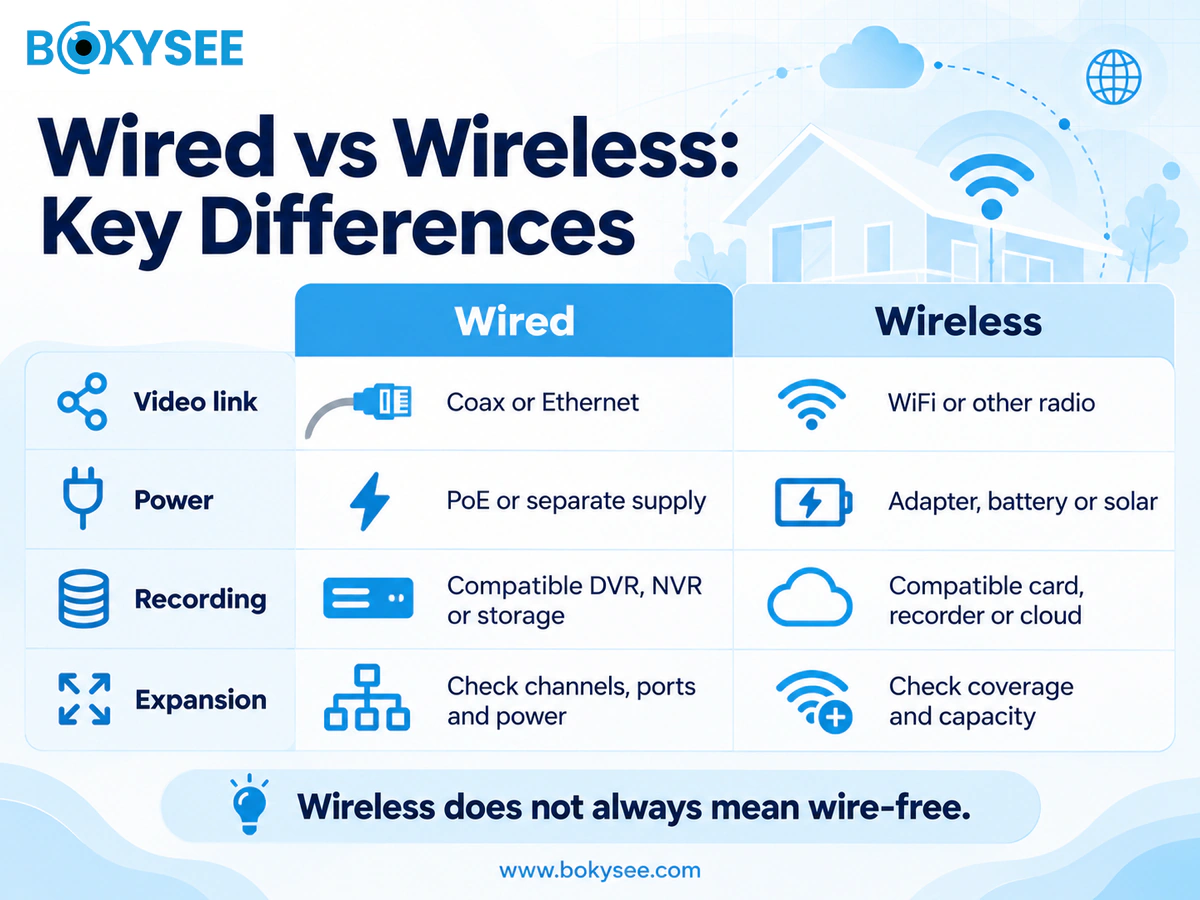
Wired and wireless security cameras are vital in helping customers choose an appropriate security camera system.
The below comparison shows eight factors that need to be considered.
| Comparison Factor | Wired Security Camera | Wireless CCTV Camera |
| Video Connection | Physical coaxial or Ethernet cable | Wireless transmission, usually WiFi |
| Fuente de alimentación | Cable, PoE, or separate power source | Battery, solar, or wired power |
| Instalación | Requires cable routing | Often simpler to install |
| Estabilidad de la conexión | Generally consistent with proper cabling | Depends on wireless signal quality |
| Internet Requirement | Depends on remote-access features | Internet usually needed for remote cloud access |
| Recording Options | DVR, NVR, server, or local storage | Cloud, memory card, or compatible recorder |
| Mantenimiento | Cable and equipment inspection | Battery, signal, and device checks |
| Expansion | May require additional cables and ports | Depends on network capacity and signal coverage |
1. Video Connection
The wired security cameras send images via coaxial cables or Ethernet cables. The method of sending signals gives the direct link for communication between cameras and the corresponding devices for recording images. It will depend on the analog HD or IP system.
The CCTV cameras wireless send signals via WiFi or via wireless connections. The cameras do not need extensive video cabling. Nevertheless, their effectiveness is dependent on the signal strength and interference.
2. Power Supply
The wired security cameras can either be powered using their own power supply or through the PoE system. The PoE provides both the electrical and the data to the camera through a single cable. Such an arrangement works well for security surveillance cameras that should operate all the time.
Wireless CCTV security cameras can use batteries that can be recharged, solar panels that work under certain conditions, or electric adapters. The ones that use batteries are easier to install but need regular battery changes.
3. Installation
The installation of wired security cameras usually involves running wires through walls, ceilings, conduits, or other structural parts of the building. Large-scale installation may require professional technicians to guarantee appropriate connections, correct cable length, and compatibility with recording equipment. The difficulty of installation is contingent upon the layout of the property.
Wireless CCTV cameras usually entail fewer wires, facilitating a faster installation process at multiple locations. Users are able to install cameras at any location that will have wireless coverage. However, considerations like power source, mounting, and testing will affect the process of installation and total cost.
4. Connection Stability
A wired CCTV camera typically offers consistent video transmission in cases where the cable connections and equipment are correctly put in place. It is ideal for use in places that need reliable monitoring, such as warehouses, offices, and commercial premises. However, problems in the cables or equipment may affect connectivity.
The effectiveness of a wireless CCTV camera relies on factors like signal strength, traffic on the network, physical barriers, and interference from other devices. Connection problems may lead to late video delivery, poor-quality videos, or a lack of connection altogether.
5. Internet Requirement
The wired security cameras do not necessarily need internet connectivity for recording purposes. Security camera systems that use DVRs or NVRs for recording do not necessarily require internet access for their operations. But for any function of remote monitoring or alerts via email, internet connectivity is a requirement.
Wireless CCTV camera systems are capable of recording without the help of internet connectivity when there are appropriate storage devices. But for remote viewing capabilities or cloud recordings, the systems would require an internet connection. Potential buyers need to differentiate between the two terms.
6. Recording Options
Recording capabilities are made possible by DVRs, NVRs, network servers, or even local storage devices, depending on the type of camera and recorder. Centralized recording capabilities can be achieved with this security camera system, making them ideal for companies that want to monitor many places at once.
Wireless CCTV cameras are capable of recording video through memory cards, compatible recorders, or the cloud. The number of recording options is offered by different brands, and some require users to have a subscription service in order to use the cloud services.
7. Maintenance
Periodic monitoring of cables, connectors, power source, and recording devices is essential for wired security camera systems. Any damage done to the wiring and any loose connections may impair their effectiveness.
On the other hand, wireless security cameras require periodic examination of the battery, connection, software/firmware, and recording features.
Battery-operated systems will occasionally need charging depending on their utilization. In addition, solar-powered cameras will occasionally need an appropriate positioning of the panels and cleaning.
8. Expansion
The installation of new wired CCTV cameras involves additional wiring, recorder channels, network slots, and power supply.
Large-scale projects must be properly planned to incorporate additional cameras within the equipment capacities. The existing system is useful in expanding when there is enough capacity for additional units.
The installation of wireless CCTV cameras involves factors like capacity of the router, power sources, device limit, and network coverage. Large-scale projects might involve additional networking facilities. Users must assess their surveillance needs before making purchases to avoid equipment replacement. wireless CCTV camera.
Wired Vs Wireless Security Camera: Which Offers Better Video Quality?
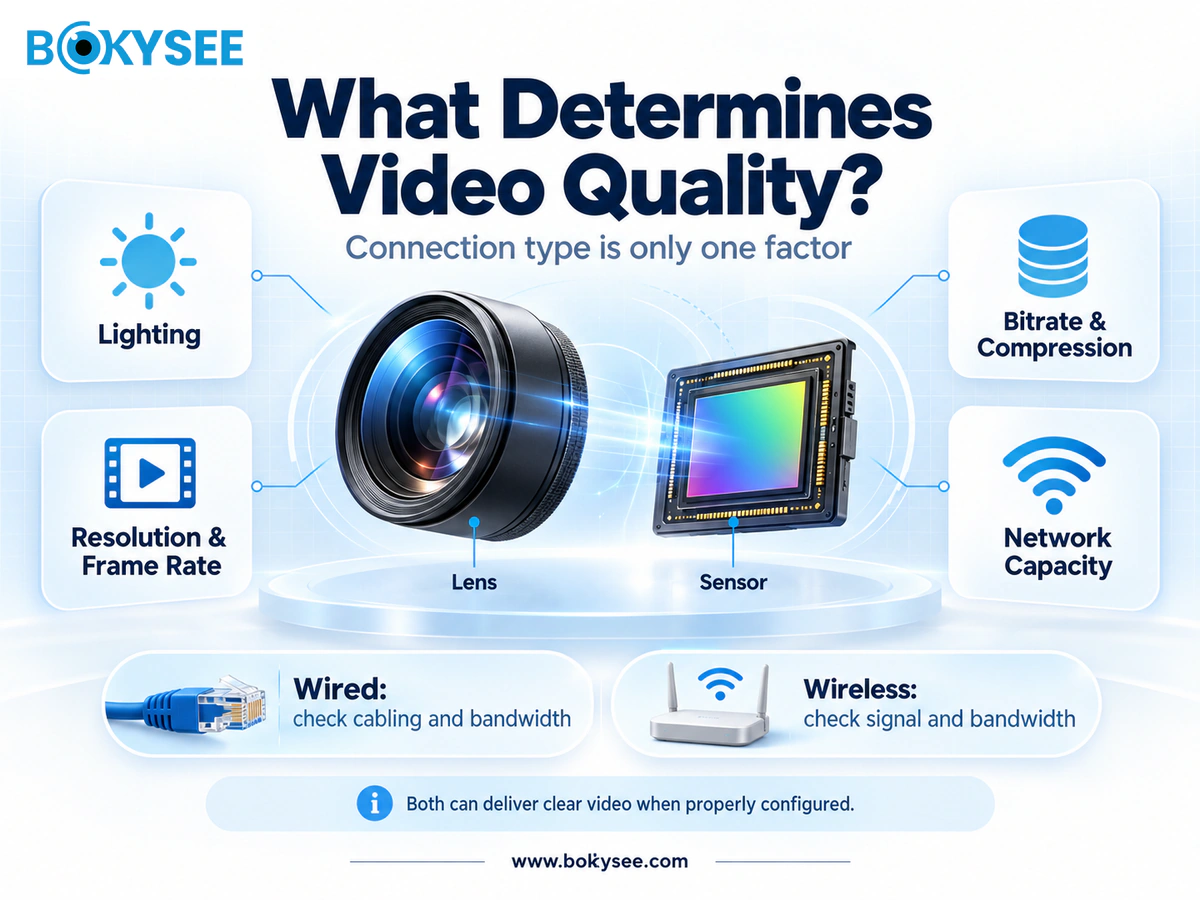
The quality of videos is determined by the camera’s hardware as well as its lighting and transmission capabilities and not just the mode of connection to it.
Both the wired and wireless security cameras can produce high-quality videos when the necessary settings have been met.
Quick Comparison of Wired Vs Wireless Security Camera
| Comparison Factor | Wired Security Camera | Wireless CCTV Camera |
| Supported Resolution | HD, 4MP, 5MP, and 4K, depending on model | HD, 4MP, 5MP, and 4K, depending on model |
| Image Detail | Depends on lens, sensor, and lighting | Depends on lens, sensor, and lighting |
| Bandwidth Stability | Generally predictable with proper network configuration | Depends on WiFi capacity and signal strength |
| Transmission Issues | Possible due to cable faults or network congestion | Possible due to interference or weak signals |
| Best Performance | Reliable cabling and sufficient network capacity | Strong WiFi coverage and sufficient bandwidth |
WiFi Security Camera vs PoE Camera
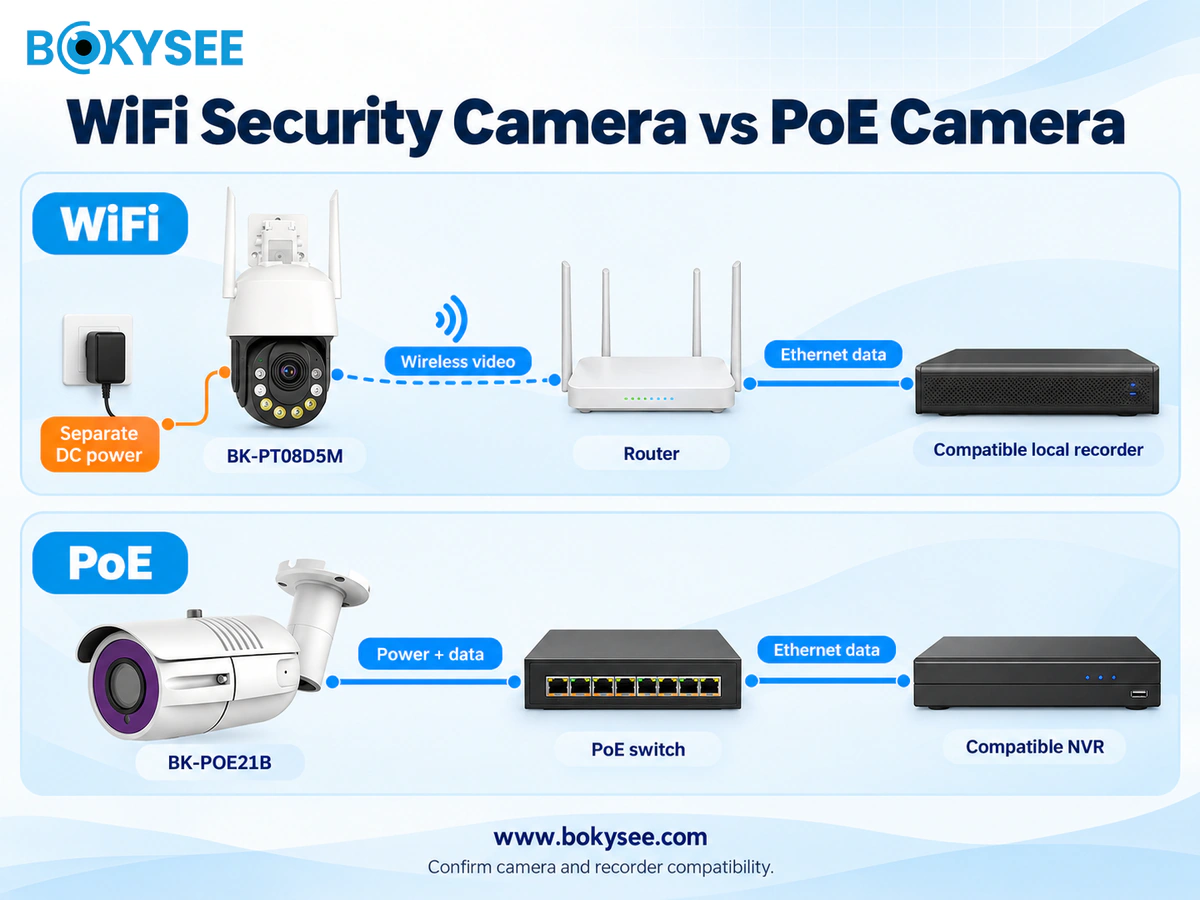
The use of WiFi and PoE cameras presents benefits based on the conditions of their installation.
There are different reasons to prefer one solution over another.
Which Camera Is Better for Your Installation?
| Requirement | Cámara WiFi | PoE Camera |
| Instalación | Colocación flexible | Requires Ethernet cabling |
| Fuerza | Battery, solar, or adapter | Compatible PoE equipment |
| Conectividad | Depends on wireless coverage | Depends on cable and network quality |
| Mantenimiento | May require battery charging | Requires cable and equipment checks |
| Ideal Use | Homes and small offices | Commercial and large-scale projects |
Recommendation: Opt for WiFI cameras in cases where the ease of installation is essential. Opt for PoE cameras in cases where you need a more reliable wired connection.
Wired Vs Wireless Security Cameras For Different Applications
Determining whether wired and wireless security cameras should be installed depends on the configuration of the property, the objective of surveillance, and the installation environment.
There are some places where it is necessary to install a camera that records continuously and can be centrally monitored, while there are others where flexibility in location and ease of installation is important.
The table below shows some good camera choices for various uses.
| Application | Recommended Camera Type | Main Reason |
| Residential Interiors | WiFi or wired | Flexible monitoring based on coverage and installation needs |
| Small Retail Stores | Wired or wireless | Depends on camera count and recording requirements |
| Warehouses | Wired IP or PoE | Supports continuous recording and centralized monitoring |
| Office Buildings | Wired IP or PoE | Provides structured connectivity and scalable deployment |
| Temporary Construction Sites | Wireless or solar-powered | Simplifies installation where infrastructure is limited |
| Estacionamientos | Wired or specialized wireless | Depends on coverage distance, power, and network availability |
| Remote Entrances | Wireless or cellular | Suitable where conventional cabling is difficult |
| Large Industrial Facilities | Wired IP or hybrid | Supports extensive coverage and centralized management |
How to Choose the Right Option?
Wireless cameras would be more convenient for residential houses and small shops where there is stable WiFi connection. Wired cameras could be chosen if constant recording and reliable connection are important.
Wired IP or PoE cameras could work well in warehouses, offices, and industries. Construction sites, distant doors, and places without infrastructure could use wireless, cell phone, or solar cameras. Think about power supply, recording needs, WiFi, and plans for the future before buying an outdoor wireless camera.
Common Mistakes To Avoid When Choosing A Security Camera
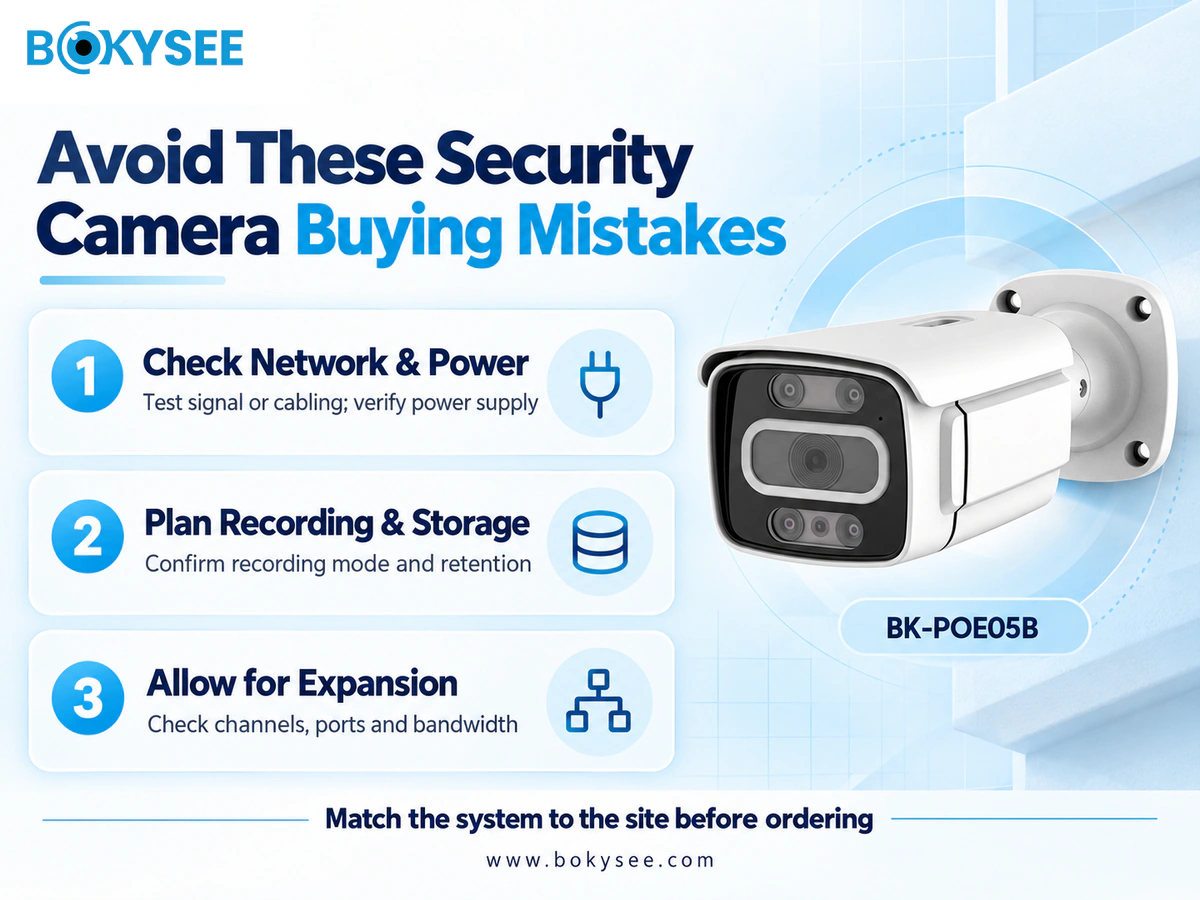
Selecting an appropriate security camera goes beyond the comparison of costs and the listed specifications. Consumers need to assess their installation needs, recording features, and future surveillance requirements prior to purchasing the equipment.
By not making these mistakes, consumers can save money and have effective security cameras security camera system
1. Ignoring Network and Power Requirements
Choosing a WiFi camera without assessing the range of the WiFi signal would lead to connectivity issues. The same is true for PoE cameras because they need the appropriate switches and recorders and have enough power to operate properly.
2. Overlooking Recording and Storage Needs
Excellent footage becomes meaningless in the absence of enough footage. Storage requirements vary according to resolution, frame rates, compression, schedules of recordings, and time span of retention. The purchaser must be able to estimate storage requirements before deciding on a camera system.
3. Failing to Plan for Future Expansion
The security system can be needed to have more cameras, surveillance zones, or even a management system in the future. Buyers need to see how many recorder channels, network ports, and compatible devices exist in advance. This would help businesses save money from further expenses.
How to Choose Between Wired and Wireless Security Cameras?
When deciding whether to go for a wired or wireless security camera, the buyer needs to undertake an analysis of the following aspects of the property: its layout, security requirements, installation environment, and budget. wired security camera.
Security Camera Selection Checklist
Before placing an order, evaluate these essential requirements:
● Coverage Areas: Identify entrances, offices, storage areas, and outdoor locations requiring monitoring.
● Recording Needs: Decide between continuous recording and motion-triggered recording.
● Connectivity: Check WiFi coverage, Ethernet cabling, and network capacity.
● Camera Features: Compare resolution, lens specifications, and night vision capabilities.
● Storage Capacity: Calculate recording space and required footage retention periods.
● Environmental Protection: Verify weather resistance for outdoor installations.
● Total Costs: Consider equipment prices, installation expenses, and maintenance.
● Compatibility: Check existing recorders, monitoring software, and network equipment.
● After-Sales Support: Confirm warranty coverage, technical assistance, and expansion options.
When to Choose a Hybrid Security Camera System
Hybrid security camera systems involve the use of wired and wireless cameras to cover up for various needs in surveillance systems.
Companies may deploy PoE cameras in strategic entry and production points and use wireless cameras in locations where laying down wires is impossible.
Prior to buying, ensure that the software used in recording allows for the two cameras.
Related Security Camera Guides
Explore these related guides to learn more about wired and wireless security cameras, camera selection, and installation requirements for different surveillance projects.
Do 4G Security Cameras Need a SIM Card?
How to Extend WiFi Range for Security Cameras
Top 10 CCTV Manufacturers and Suppliers in China
How to Choose a Full-Range CCTV Camera Manufacturer for Distribution and Projects
How to Find the Best Security Camera Supplier for Wholesale or Private Label Business
Why Install Solar Powered Security Cameras at Construction Sites
Selecting the Best Solar Wireless Security Camera for Outdoor Project
How Much Sunlight Does an Outdoor Solar Security Camera Really Need?
Do Solar Security Cameras Work in Winter? Cold Weather Performance Tips
How Do Solar Security Cameras Work? A Deep Dive into Off-Grid Surveillance
Reflexiones finales
The choice of a wired or a wireless security camera will depend on such factors installation demands, connectivity issues, recording issues and operational costs.
The use of PoE cameras will be ideal from the perspective of power supply and data connectivity, whereas WiFi security cameras will be easier to install in proper places. Wired security cameras will be ideal for such businesses that have to monitor the premises continuously and need video management centralization.
In order to choose the correct security camera for your premises, you should take into account the following factors: video quality, power considerations, storage considerations, network performance and system scalability.
Looking for the right security camera system for your project? Bokysee offers security surveillance solutions for different applications. Explore our product range to find suitable IP cameras and security camera options for your residential, commercial, or industrial requirements.
Preguntas frecuentes
Which is better wired or wireless security camera?
When considering the installation of a fixed system, it is important to choose a wired surveillance camera for stable operation. So, a wireless one will be best at places where cable connections are not very necessary.
Do wireless security cameras need internet access?
It is possible to record on local storage using wireless cameras even without the internet. However, for remote viewing, cloud recording, and notifications on your phone, an internet connection is necessary.
Are wired security cameras more reliable than wireless cameras?
Generally, wired security cameras can offer reliable connectivity if the installation is done correctly. The wireless security cameras can also operate effectively if there is adequate WiFi connectivity and enough network bandwidth.
Can wireless CCTV cameras work without electricity?
Some wireless CCTVs run on rechargeable batteries and some on solar panels, depending on the kind of wireless CCTV used. This depends on the individual camera's power needs.
What is the difference between a WiFi security camera and a PoE camera?
A WiFi security camera sends its video feed over the air through the network. A PoE security camera uses the Ethernet cable for data transfer and powering the device.
Which security camera is best for outdoor use?
Outdoor wireless camera will be appropriate for places that may have challenges when installing cables. Wired IP or PoE cameras are generally appropriate for installation needs that require stable connections.
Do wired security cameras work without the internet?
Yes, wired security cameras can work offline in the absence of internet connection when paired with a suitable DVR or NVR. Nonetheless, remote monitoring and cloud capabilities typically necessitate an internet connection.
Are wireless security cameras easier to install?
Wireless security cameras tend to be easier to install because of less need for video cables. However, installation will depend on factors such as availability of power, signal strength, mounting, among others.
Which security camera system is best for businesses?
Wired IP and PoE systems are common in scenarios that demand continuous recording, centralized monitoring, and easy scalability. Wireless camera systems could be useful where it is challenging to install cables.
What should buyers check before purchasing a security camera system?
Buyers should consider resolution, connection, power supply, memory, recording capabilities, and installation costs. Buyers should also ensure compatibility, warranties, and possibilities for future expansion of the equipment.






 Spanish
 English
 Russian