Skip to content
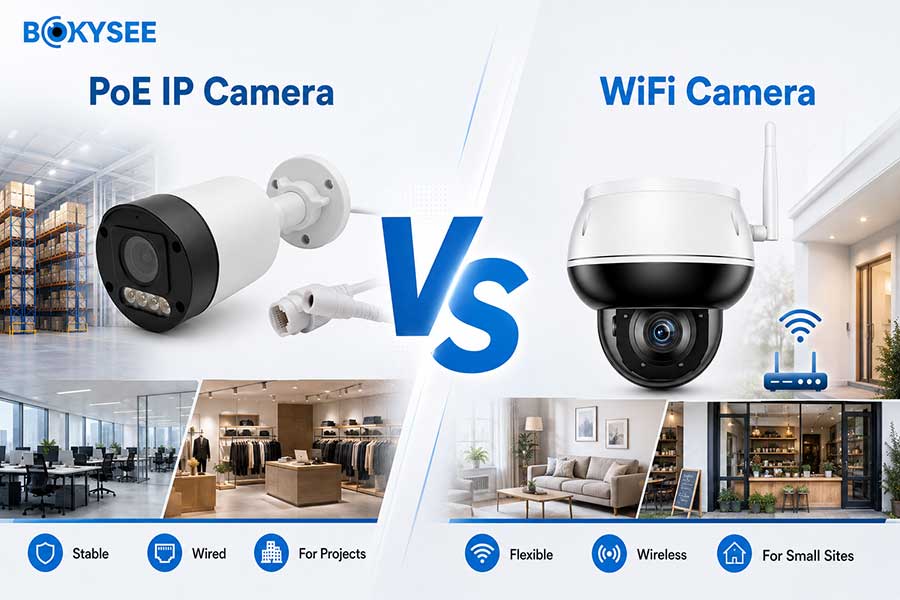
For installers, the better camera is not always the newest model, the highest resolution, or the lowest price.
The better camera is the one that matches the project site and reduces future maintenance problems.
This is especially true when choosing between a PoE IP camera and a WiFi camera. Both camera types are useful. Both can work well in the right environment. But they are not designed for the same installation logic.
A PoE IP camera is usually preferred in professional CCTV projects where stable wired transmission, local NVR recording, and long-term reliability are important. A WiFi camera is more practical when cabling is difficult, the project is small, or the installation needs more flexibility.
For CCTV installers, distributors, system integrators, and project buyers, this decision is not only technical. It affects installation time, labor cost, after-sales service, customer satisfaction, and long-term project reputation.
This guide explains how to compare PoE IP cameras and WiFi cameras from a real B2B project point of view.
Why Installers Compare PoE IP Cameras and WiFi Cameras
Many buyers ask a simple question:
-
Should I choose PoE cameras or WiFi cameras?
But for professional installers, the better question is:
-
Which camera connection method is more reliable for this project site?
A CCTV project may look simple during quotation. But after the installer arrives on site, many real problems appear.
There may be no cable route.
The walls may be too thick for WiFi signal.
The customer may need stable 24/7 recording.
The NVR may already be installed.
The project may have many cameras in different areas.
The end user may expect mobile app viewing and easy playback.
If the wrong camera type is selected, the project may face problems such as unstable video, offline cameras, difficult troubleshooting, extra installation work, or repeated service visits.
For installers, these problems directly affect profit.
A low-cost camera is not really low cost if the installer needs to return to the site many times. A flexible camera is not really flexible if the WiFi signal is unstable. A professional system is not really professional if the customer cannot play back video smoothly.
That is why installers usually compare PoE IP cameras and WiFi cameras from four practical angles:
| Key Concern | Why It Matters |
|---|---|
| Connection stability | Reduces offline cameras and video delay |
| Installation difficulty | Affects labor time and project cost |
| Maintenance convenience | Reduces future service visits |
| System compatibility | Affects NVR recording and long-term use |
For small and medium CCTV projects, these factors are often more important than product price alone.
What Is a PoE IP Camera and Why Is It Common in CCTV Projects?
A PoE IP camera is a network camera that uses Ethernet cable for both data transmission and power supply.
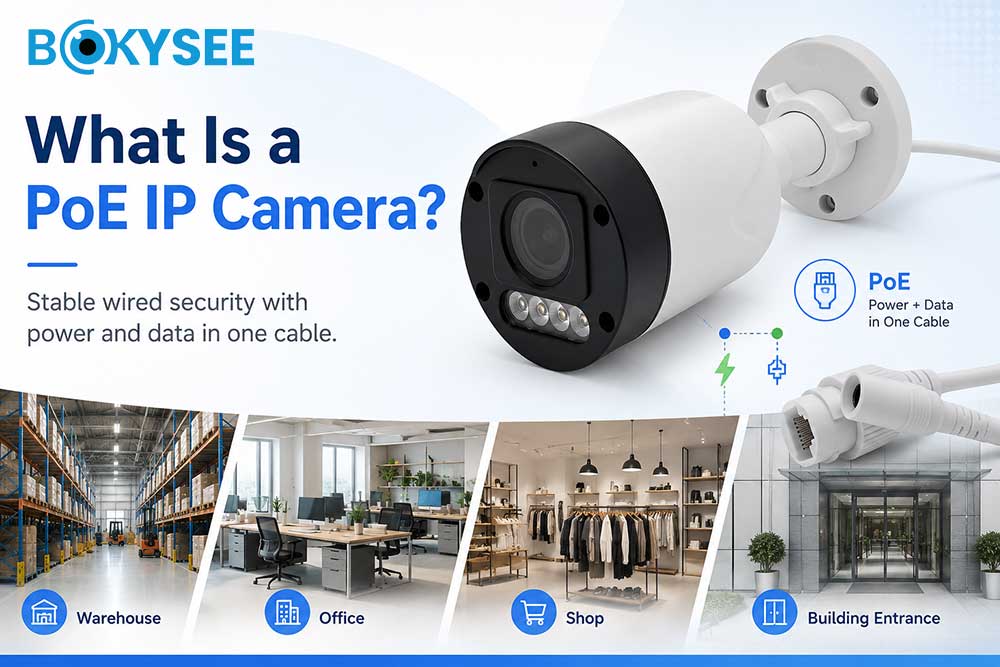
PoE means Power over Ethernet. In CCTV projects, this means one network cable can provide power to the camera and transmit video data at the same time.
For installers, this is very practical.
Instead of preparing separate power cables and network cables for each camera, a PoE system can be managed through a PoE switch or PoE NVR. This makes wiring more organized and makes the system easier to maintain.
Why PoE IP cameras are popular in professional projects
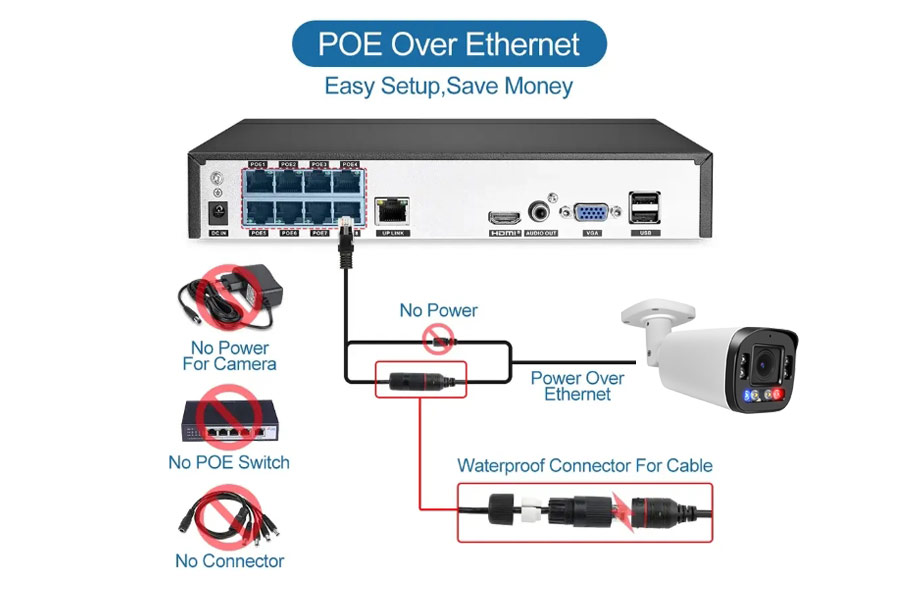
PoE IP cameras are commonly used in professional CCTV projects because they offer stable wired transmission.
Compared with wireless transmission, wired transmission is usually less affected by signal interference, wall thickness, router distance, or crowded network environments.
For projects that need stable recording and long-term operation, this is a strong advantage.
| PoE IP Camera Advantage | Practical Value for Installers |
|---|---|
| One cable for power and data | Cleaner installation and easier wiring plan |
| Wired network connection | More stable video transmission |
| Centralized power management | Easier troubleshooting through PoE switch or NVR |
| Suitable for multi-camera systems | Better for shops, warehouses, offices, and communities |
| Good NVR integration | More suitable for local recording and playback |
PoE IP cameras are especially suitable for projects where the camera position is fixed and the system needs to run continuously.
For example, a warehouse entrance, office corridor, parking lot gate, residential community, or factory perimeter usually requires stable monitoring. These are typical scenarios where PoE cameras are preferred.
Common PoE IP camera applications
PoE IP cameras are widely used in:
-
Warehouses
-
Retail shops
-
Office buildings
-
Villas
-
Residential communities
-
Factories
-
Schools
-
Parking lots
-
Commercial buildings
-
Perimeter monitoring projects
For installers and system integrators, PoE systems also look more professional. The wiring structure is clearer, the recording system is easier to manage, and the customer usually receives a more stable long-term solution.
What Is a WiFi Camera and When Is It More Practical?
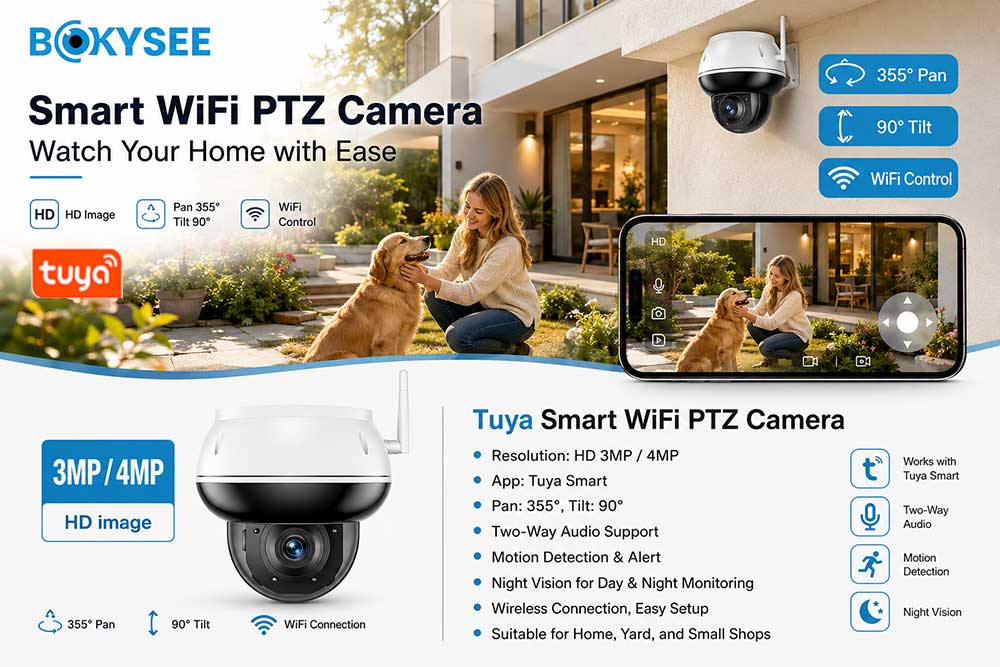
A WiFi camera connects to the network wirelessly. It usually still needs power, unless it is a battery-powered model, but video transmission is handled through the WiFi network.
WiFi cameras are popular because they are flexible and easier to install in certain environments.
They are useful when network cabling is difficult, expensive, or not allowed. For example, some customers do not want to drill walls, open ceilings, or run long cables after renovation. In these cases, WiFi cameras can reduce installation work.
Why buyers choose WiFi cameras
WiFi cameras are often selected for smaller, simpler, or more flexible projects.
They are suitable when:
-
The project has only a few cameras
-
The WiFi signal is strong and stable
-
Cabling is difficult or not cost-effective
-
The installation point may change later
-
The buyer wants quick setup
-
The customer mainly needs mobile app viewing
-
The project is indoor or light commercial
For small shops, homes, apartments, small offices, and temporary monitoring points, WiFi cameras can be a practical choice.
Practical value of WiFi cameras
| WiFi Camera Advantage | Practical Value |
|---|---|
| No network cable required | Faster installation in some sites |
| Flexible camera position | Useful for small or temporary projects |
| App-friendly use | Easy for homeowners and small business users |
| Lower wiring work | Suitable for finished buildings |
| Good for small systems | Works well when camera quantity is limited |
However, WiFi cameras depend heavily on the wireless environment.
If the router is far away, the wall is thick, the signal is weak, or many devices share the same network, the camera may experience video delay, disconnection, or unstable remote viewing.
This does not mean WiFi cameras are poor products. It means they need the right site condition.
For installers, the key is to check the network environment before recommending WiFi cameras.
PoE IP Camera vs WiFi Camera: Key Comparison for Installers
The difference between PoE and WiFi cameras is not only “wired vs wireless.”
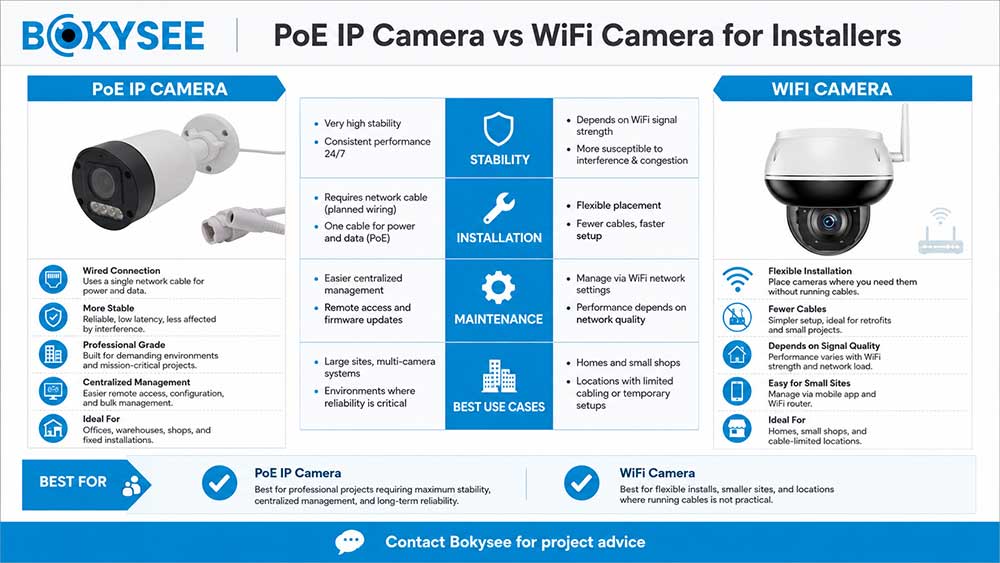
For CCTV project buyers, the real difference is how each system performs during installation, operation, and maintenance.
PoE IP Camera vs WiFi Camera Comparison Table
| Factor | PoE IP Camera | WiFi Camera |
|---|---|---|
| Connection Method | Wired Ethernet cable | Wireless network |
| Power Supply | Through PoE switch or PoE NVR | Power adapter or battery, depending on model |
| Stability | Usually more stable | Depends on WiFi signal quality |
| Installation Work | Requires cable planning | Less network cabling required |
| Best For | Professional CCTV projects | Small or flexible installations |
| Maintenance | Easier to trace cable and network issues | Signal problems may be harder to diagnose |
| Multi-Camera Projects | More suitable | May become unstable with too many cameras |
| NVR Recording | Common and stable | Depends on model, network, and compatibility |
| Remote Viewing | Stable if network design is good | Convenient, but depends on WiFi and internet |
| Project Image | More professional | More flexible and simple |
Stability
For professional installers, stability is often the most important point.
PoE cameras use wired transmission. This makes them less affected by signal interference, router distance, wall structure, and wireless congestion.
WiFi cameras depend on wireless signal strength. If the signal becomes weak, the video may delay or the camera may go offline.
For one or two cameras, this may not be a big problem. But for larger projects, unstable WiFi can create repeated after-sales pressure.
Installation
PoE cameras need cable planning. This means the installer must consider cable routes, switch position, NVR location, and installation distance.
This can take more work at the beginning.
However, once the system is installed correctly, it is usually more stable and easier to manage.
WiFi cameras can be faster to install when cabling is difficult. But the installer still needs to check power supply, WiFi coverage, router capacity, and signal stability.
So WiFi is not always easier. It is easier only when the site network is suitable.
NVR and system integration
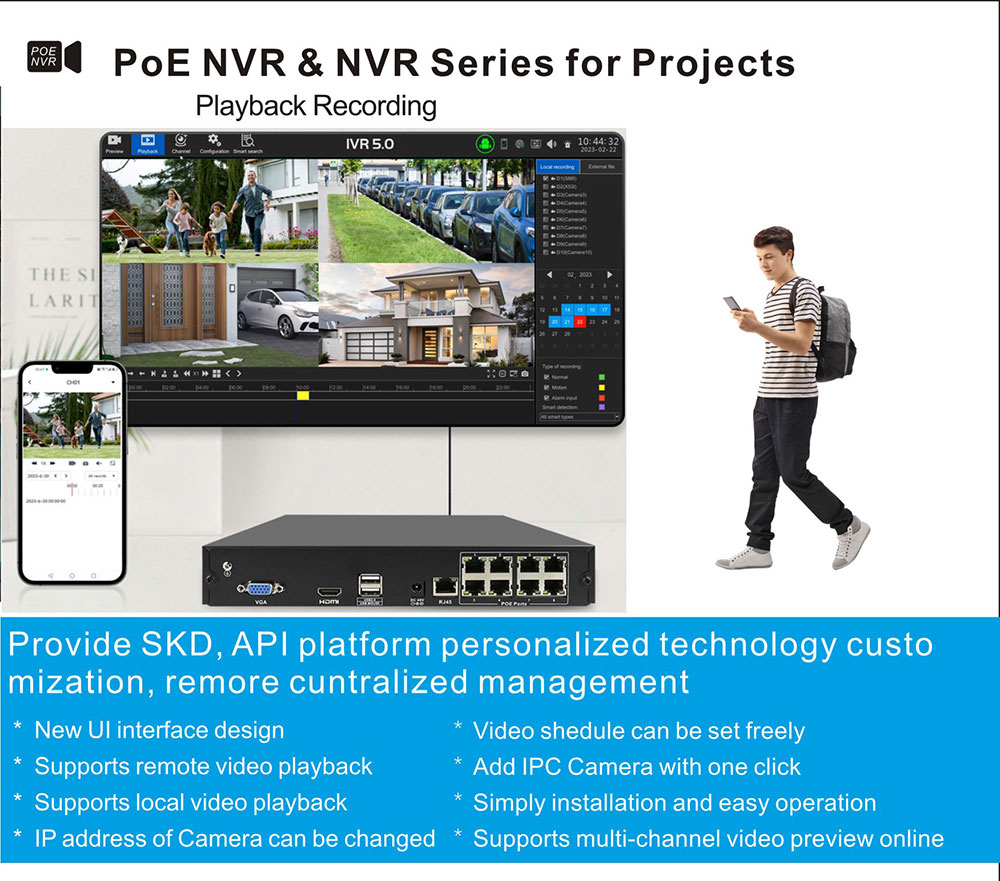
PoE IP cameras are commonly used with NVR systems. This is important for projects that require local recording, stable playback, and centralized camera management.
WiFi cameras can also connect to NVRs in some systems, but it depends on the camera model, protocol, network environment, and NVR compatibility.
For third-party systems, buyers should check whether the camera supports ONVIF and test it with the actual NVR before bulk order.
For installers, sample testing is always safer than assuming compatibility from a specification sheet.
Maintenance
PoE systems are usually easier to troubleshoot.
If a PoE camera goes offline, the installer can check the cable, PoE port, switch, NVR, and camera one by one. The system structure is clear.
WiFi systems can be harder to diagnose because the problem may come from signal interference, router settings, distance, walls, bandwidth, or internet quality.
For small projects, this may be acceptable. For professional multi-camera projects, it may increase service cost.
How to Choose the Right Camera Type for Different Project Scenarios
There is no single best choice for every project. The right choice depends on the site layout, installation environment, camera quantity, recording needs, and customer expectations.
Retail shops
For small shops, both PoE and WiFi cameras can work.
If the shop only needs a few indoor cameras and the WiFi signal is strong, WiFi cameras can be convenient.
But if the shop needs stable recording, multiple cameras, and NVR playback, PoE cameras are usually a better choice.
Recommended option:
PoE cameras for professional shop systems.
WiFi cameras for simple indoor monitoring.
Warehouses
Warehouses usually need stable 24/7 monitoring.
They may have large spaces, metal shelves, loading areas, long distances, and more signal interference. WiFi may not be stable enough for all camera points.
Recommended option:
PoE bullet cameras for entrances, aisles, loading areas, and storage zones.
PTZ cameras can be added for wide outdoor yards.
Villas and residential projects
Villas often need cameras at gates, garages, doors, gardens, and perimeter walls.
If cable routes are available, PoE cameras are better for outdoor and fixed monitoring points. WiFi cameras can be used for indoor flexible areas.
Recommended option:
PoE cameras for outdoor security points.
WiFi cameras for indoor or flexible monitoring.
Offices
Office projects usually need stable monitoring at entrances, corridors, reception areas, and public zones.
If the project is installed as a professional system, PoE dome cameras and PoE bullet cameras are usually preferred.
Recommended option:
PoE cameras with NVR recording.
Parking lots
Parking lots require wide-area monitoring, stable outdoor operation, and sometimes PTZ cameras.
WiFi is usually not the best choice for large parking areas because camera points may be far away from routers.
Recommended option:
PoE bullet cameras and PTZ cameras.
Construction sites
Construction sites are more complex.
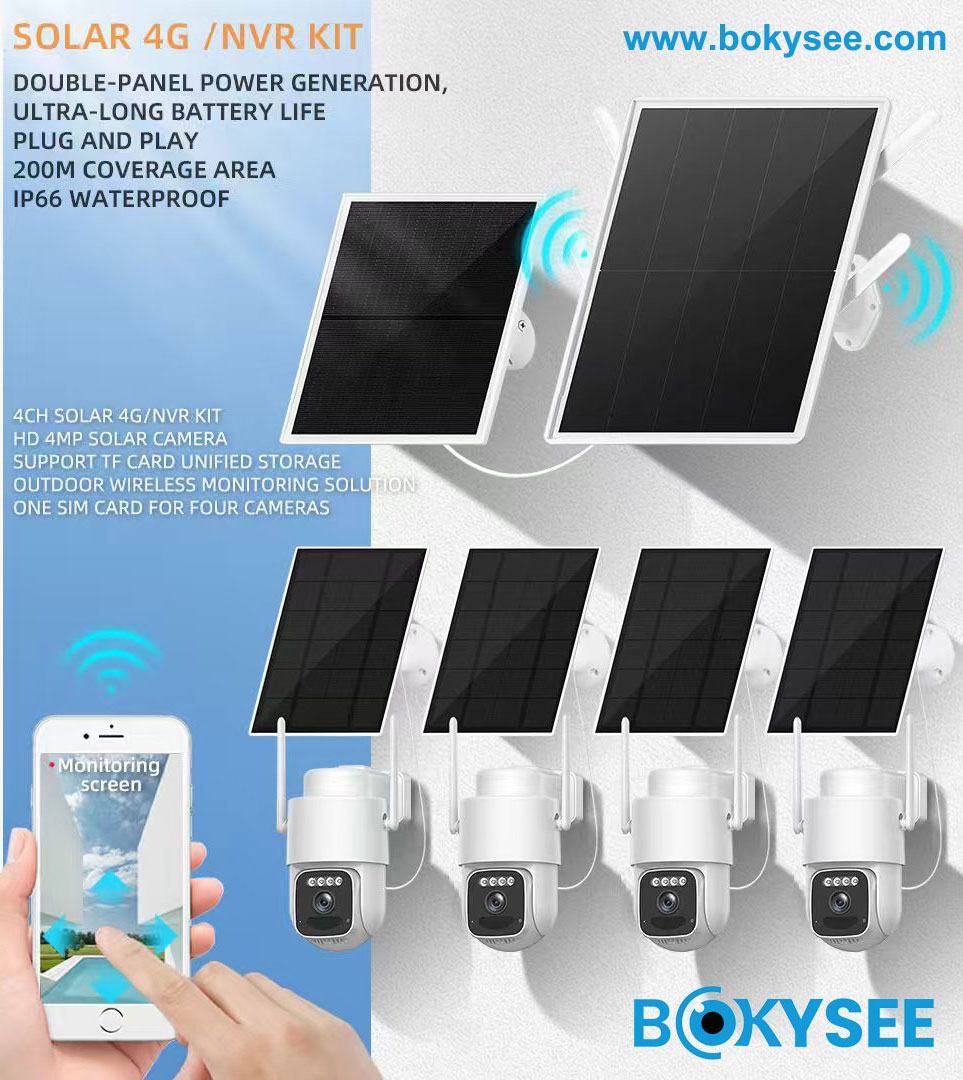
If power and wired network are available, PoE cameras can work well. If the site has no stable power or network, WiFi cameras may not solve the problem. In this case, 4G solar cameras may be more practical.
Recommended option:
PoE cameras where cable and power are available.
4G solar cameras for remote or temporary monitoring points.
Temporary monitoring
For short-term indoor projects, WiFi cameras may be convenient.
For outdoor or remote temporary sites, a 4G solar camera may be more suitable than a normal WiFi camera.
Recommended option:
WiFi cameras for simple temporary indoor use.
4G solar cameras for remote temporary sites.
Cost, Maintenance, and Long-Term Reliability for CCTV Project Buyers
Many buyers compare PoE and WiFi cameras by product price only.
But for B2B CCTV projects, product price is only one part of the real cost.
A more practical comparison should include:
-
Product cost
-
Installation labor
-
Cable and accessory cost
-
Network device cost
-
NVR and storage cost
-
Maintenance cost
-
Return rate risk
-
Customer complaint risk
-
Future upgrade difficulty
PoE project cost
PoE systems may require more cable work at the beginning. The installer may need Ethernet cables, PoE switches, PoE NVRs, connectors, and more planning time.
But after installation, the system is usually more stable and easier to maintain.
For projects that require long-term operation, this can reduce future service cost.
WiFi project cost
WiFi cameras may reduce cabling cost, especially for small or finished sites.
However, if the WiFi signal is unstable, the installer may need to add routers, repeaters, access points, or return to the site for troubleshooting.
This can increase the real project cost.
Long-term reliability
For wholesalers, distributors, and installers, long-term reliability is very important.
If a product creates many after-sales problems, it affects local reputation. If a system frequently goes offline, the customer may blame the installer, not only the camera brand.
That is why many professional CCTV buyers prefer PoE cameras for project-based installations.
WiFi cameras are still valuable, but they should be used in the right environment.
Supplier support also matters
The camera type is important, but the supplier behind the product is also important.
Before bulk order, B2B buyers should check:
| Supplier Factor | Why Buyers Should Care |
|---|---|
| Product consistency | Reduces quality variation in bulk orders |
| ONVIF and NVR support | Helps avoid compatibility issues |
| Lead time reliability | Supports project delivery schedules |
| OEM/ODM capability | Helps build buyer’s local brand |
| Technical communication | Reduces installation and after-sales pressure |
| Packaging readiness | Supports wholesale and distribution needs |
A reliable CCTV supplier should help buyers select the right product, not only provide a price list.
For installers and system integrators, this kind of support can make project delivery much smoother.
Frequently Asked Questions About PoE IP Cameras and WiFi Cameras
1. Is a PoE IP camera better than a WiFi camera?
For professional CCTV projects, PoE IP cameras are usually more stable because they use wired transmission. WiFi cameras are better for small, flexible, or difficult-to-wire installations.
The better choice depends on the project site.
2. Do PoE IP cameras need a separate power adapter?
Usually no. A PoE IP camera receives power and data through one Ethernet cable from a PoE switch or PoE NVR.
Buyers should confirm that the PoE switch or NVR has enough power capacity for all cameras.
3. Are WiFi cameras suitable for NVR recording?
Some WiFi cameras can connect to an NVR, but it depends on the camera model, protocol, network quality, and NVR compatibility.
For project orders, sample testing with the actual NVR is recommended.
4. Which camera type is better for outdoor projects?
For most outdoor professional projects, PoE cameras are more reliable because the wired connection is more stable.
WiFi cameras can be used outdoors only when the signal is strong and the camera position is close enough to the router or access point.
5. How should installers choose between PoE and WiFi cameras?
Installers should check the site layout, cable route, WiFi signal, camera quantity, NVR requirement, and maintenance expectations.
If the project needs stable 24/7 recording, choose PoE. If the project is small and cabling is difficult, WiFi may be more practical.
Final Recommendation for Installers
PoE IP cameras and WiFi cameras both have value.
But they fit different project needs.
Choose PoE IP cameras when the project requires:
-
Stable 24/7 recording
-
NVR integration
-
Multi-camera installation
-
Outdoor monitoring
-
Warehouse or commercial coverage
-
Lower long-term maintenance risk
-
More professional system structure
Choose WiFi cameras when the project requires:
-
Flexible installation
-
Less cabling work
-
Small camera quantity
-
Indoor or light commercial use
-
Simple app-based viewing
-
Temporary monitoring
-
Fast setup in a finished building
For installers, the best choice should not be based on one feature alone.
It should be based on the site condition, customer expectation, installation difficulty, and future maintenance reality.
A camera that is easy to sell but difficult to maintain is not a good project choice.
A camera that fits the site, works reliably, and is supported by a dependable supplier is the better long-term solution.
How Bokysee Supports Installers and Project Buyers
Bokysee provides a full range of CCTV security products for overseas installers, distributors, system integrators, wholesalers, and project contractors.
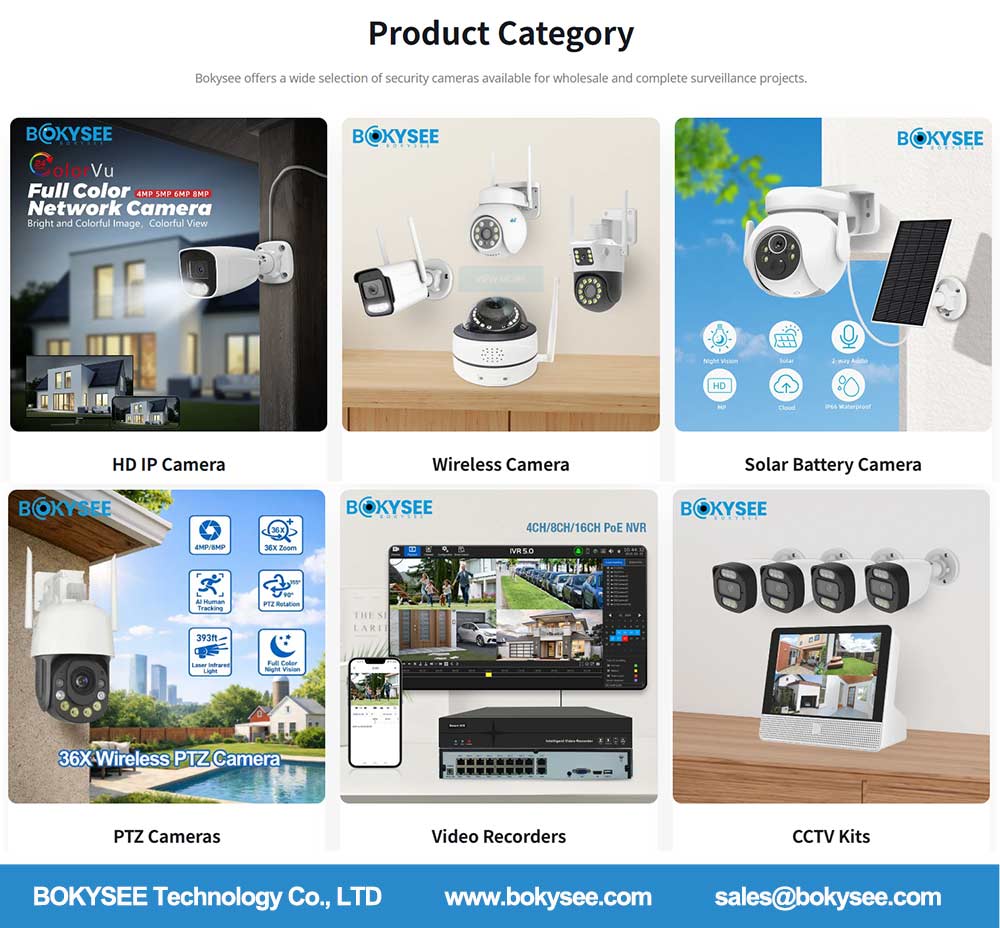
Our product range includes:
-
PoE IP cameras
-
Smart WiFi cameras
-
PTZ cameras
-
Solar battery cameras
-
NVRs and DVRs
-
CCTV kits
-
OEM/ODM security camera solutions
For CCTV project buyers, Bokysee can help compare PoE and WiFi options based on real installation needs. We can also support model selection, NVR matching, ONVIF compatibility checks, OEM branding, packaging, and sample testing.
If you are not sure whether PoE or WiFi cameras are better for your project, send us your site type, camera quantity, installation environment, and target market.
Bokysee will help recommend a practical CCTV solution that fits your project, budget, and long-term business needs.
See Also
Understanding Full Color IP Cameras And Their Key Advantages
Emerging IP Camera Innovations In 2025 For Better Security
Essential Guide To Purchasing 4G Security Cameras
Guide To Encoding Settings For Bokysee IP Cameras
Key Differences Between IP Camera Systems And Traditional Models







 English
  Spanish
  Russian