Skip to content
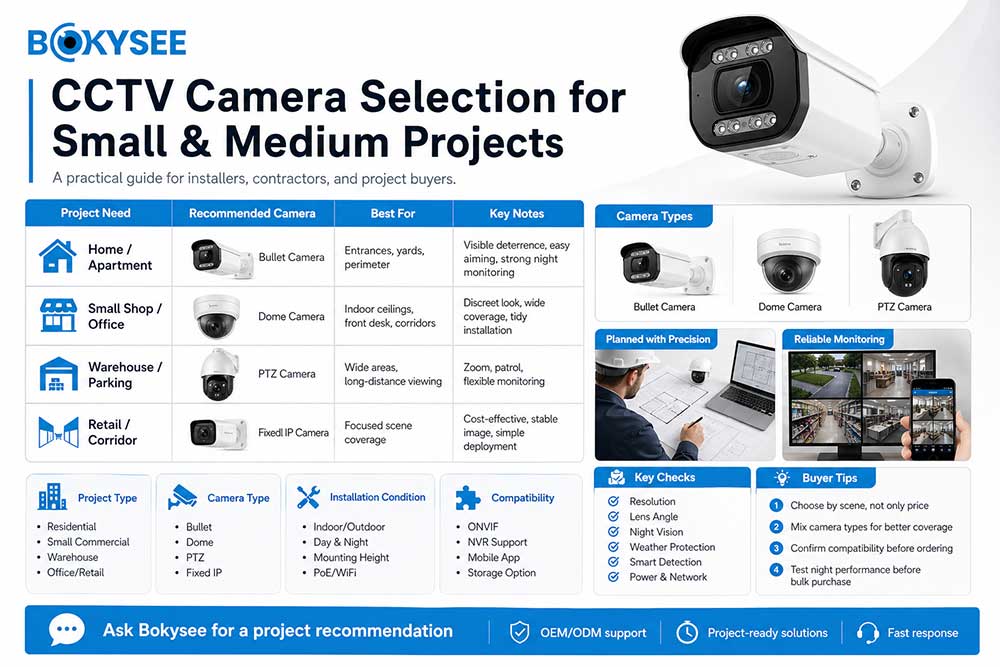
Choosing the right CCTV camera for a small or medium security project is not only about resolution, price, or product appearance.
For installers, distributors, system integrators, and project buyers, the real question is much more practical:
Will this camera work reliably in the actual project environment?
A camera that looks good on a product sheet may still create problems on site if the lens is not suitable, the night image is weak, the NVR compatibility is unclear, or the supplier cannot support stable delivery. For small and medium security projects, these problems can quickly become installation delays, customer complaints, extra labor cost, or after-sales pressure.
This is why CCTV camera selection should always start from the project, not from the product alone.
Today, video security is moving toward smarter, more connected, and more proactive systems. Industry discussions around 2026 video surveillance trends often highlight AI video analytics, remote monitoring, cloud-connected systems, and intelligent edge devices as important directions for modern security projects. But for many small and medium projects, the foundation is still very clear: stable cameras, suitable installation, good night visibility, reliable recording, and easy system integration.
This guide is written for B2B buyers who need to choose CCTV cameras for real projects, including shops, warehouses, villas, residential communities, factories, offices, parking lots, and construction sites.
Why CCTV Camera Selection Matters for Small and Medium Security Projects
Small and medium CCTV projects often have limited budgets, limited installation time, and limited room for mistakes.
A large enterprise project may have a professional design team, multiple rounds of testing, and a higher technical budget. But a small warehouse, retail shop, villa, parking area, or residential compound usually needs a faster and more practical solution.
That means every product choice matters.
A wrong camera selection can cause several problems:
| Wrong Selection | Possible Project Problem |
|---|---|
| Lens too narrow | Important areas are not fully covered |
| Lens too wide | Important details such as faces or plates are unclear |
| Weak night vision | Customer cannot identify people at night |
| Poor waterproof design | Outdoor failure after rain or humidity |
| Unstable WiFi connection | Video loss and customer complaints |
| Unknown NVR compatibility | Extra configuration time on site |
| Low-cost unstable product | Higher return rate and after-sales cost |
For B2B buyers, the cost of a bad camera is not only the product cost. It also includes technician time, customer trust, replacement shipping, and future cooperation risk.
This is especially important for installers and system integrators. Your customer may not understand chipset, bitrate, lens angle, or ONVIF profile. But they will notice if the image is unclear, if playback is missing, or if the system is difficult to maintain.
So a good CCTV camera selection guide should help you answer three questions:
-
What does the site need to monitor?
-
Which camera type fits the installation environment?
-
Can the full system remain stable after installation?
At Bokysee, we usually suggest project buyers think in terms of “site fit” first. Product specifications are important, but they should serve the project goal.
How to Match IP Cameras, PoE Cameras, PTZ Cameras, and CCTV Kits to Each Site
Different CCTV camera types are designed for different project needs. A good project solution often uses more than one camera type.
For example, a warehouse may need fixed bullet cameras for entrances, dome cameras for indoor areas, PTZ cameras for wide outdoor yards, and an NVR for centralized recording. A villa may need smart WiFi cameras for indoor use, PoE cameras for outdoor entrances, and a small CCTV kit for easier installation.
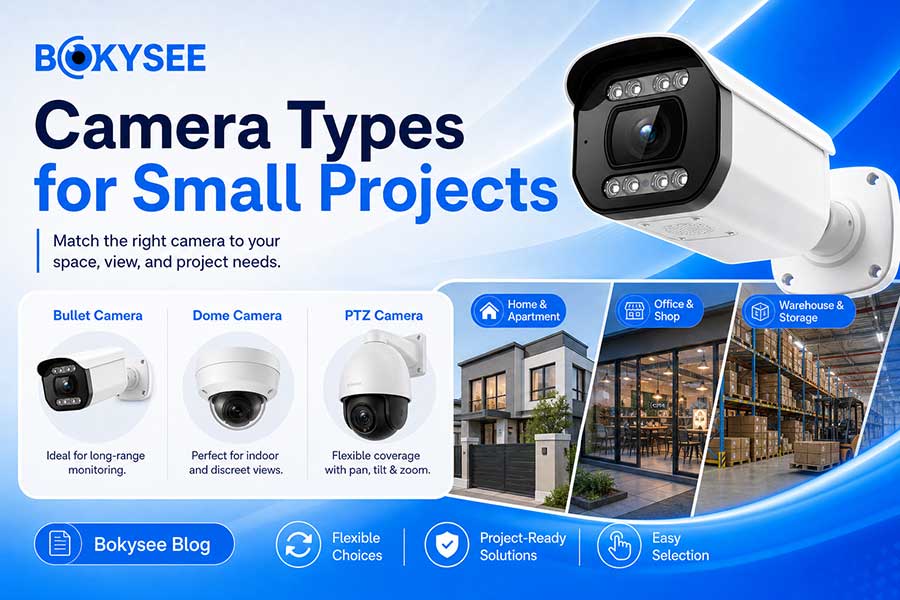
Here is a practical way to match camera types to project scenes.
| Camera Type | Best For | Buyer Benefit |
|---|---|---|
| Bullet IP Camera | Outdoor walls, entrances, corridors, perimeter areas | Clear direction, easy installation, strong visual deterrence |
| Dome IP Camera | Indoor ceilings, offices, shops, public areas | Clean appearance, protected housing, suitable for indoor projects |
| PoE IP Camera | Stable wired projects, warehouses, offices, communities | One cable for power and data, easier maintenance |
| PTZ Camera | Large areas, yards, roads, parking lots, perimeter monitoring | Pan, tilt, zoom coverage with fewer cameras |
| Smart WiFi Camera | Homes, small shops, light commercial use | Flexible installation and app-based viewing |
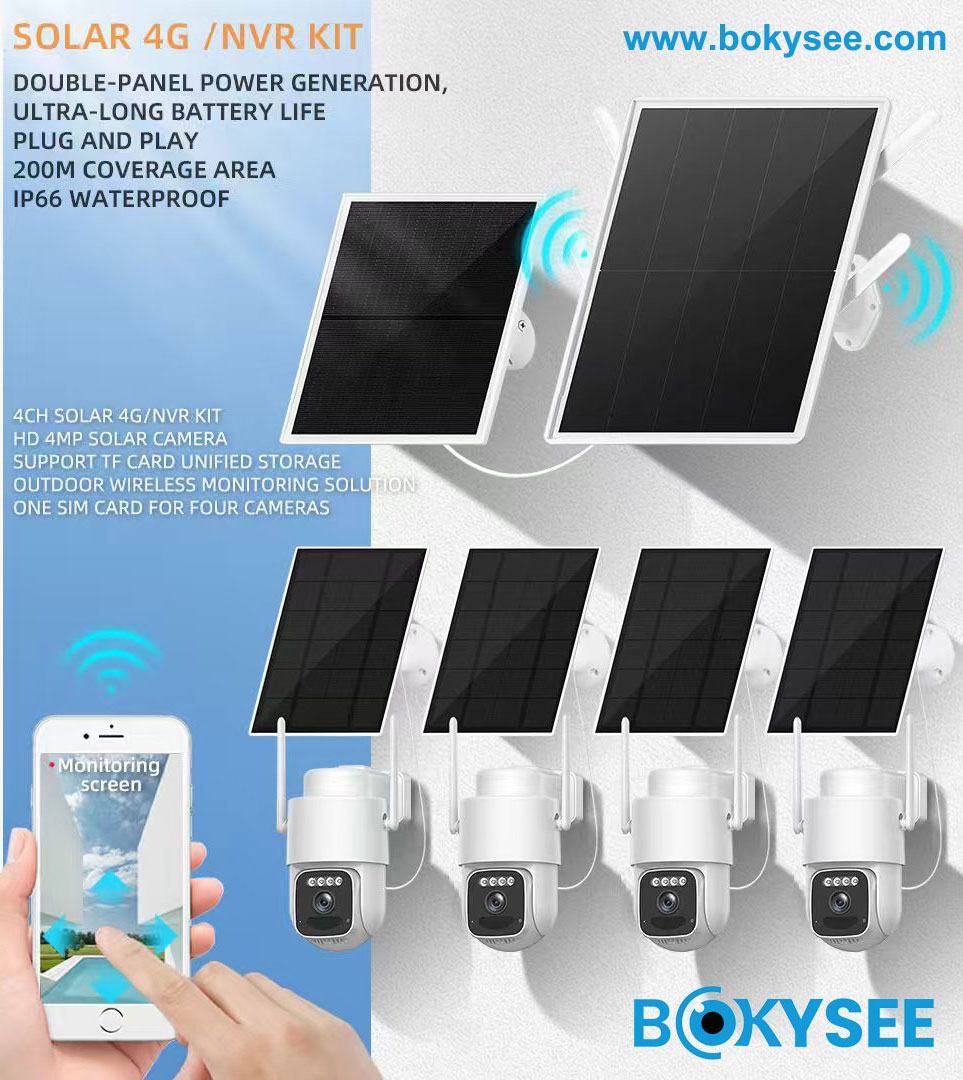
| 4G Solar Camera | Remote areas, farms, construction sites, temporary sites | Works where power and network are limited |
| CCTV Kit | Small businesses, villas, stores, simple projects | Faster setup, easier product matching, lower decision cost |
For most professional small and medium projects, PoE IP cameras are often a reliable choice because they use one Ethernet cable for both power and data. Cisco describes Power over Ethernet as a technology that delivers DC power over copper Ethernet cabling without separate power supplies or outlets. In practical CCTV installation, this helps reduce wiring complexity and makes the system easier to maintain.
However, PoE is not always the only answer. If the site cannot be wired easily, WiFi cameras or 4G solar cameras may be more suitable. If the project needs wide-area monitoring, a PTZ camera can reduce blind spots and improve coverage flexibility.
The right choice depends on the site, not only the camera category.
For example:
Retail shop:
Use dome cameras for indoor customer areas, bullet cameras for entrance points, and a small NVR for recording.
Warehouse:
Use PoE bullet cameras for doors and loading bays, dome cameras for office areas, and PTZ cameras for outdoor yards.
Villa or residential project:
Use PoE cameras for entrances and outdoor walls, smart cameras for indoor flexible monitoring, and an NVR or kit for local recording.
Construction site:
Use 4G solar cameras when power and network are unstable, plus PTZ cameras for large temporary areas.
Parking lot:
Use bullet cameras for entrances, PTZ cameras for wide-area monitoring, and high-resolution cameras for key points.
A strong CCTV solution does not always use the most expensive product. It uses the most suitable product for each monitoring point.
Key Installation Factors: Coverage, Lens, Night Vision, Storage, and Network Stability
After choosing the basic camera type, buyers should check several technical factors that directly affect project performance.
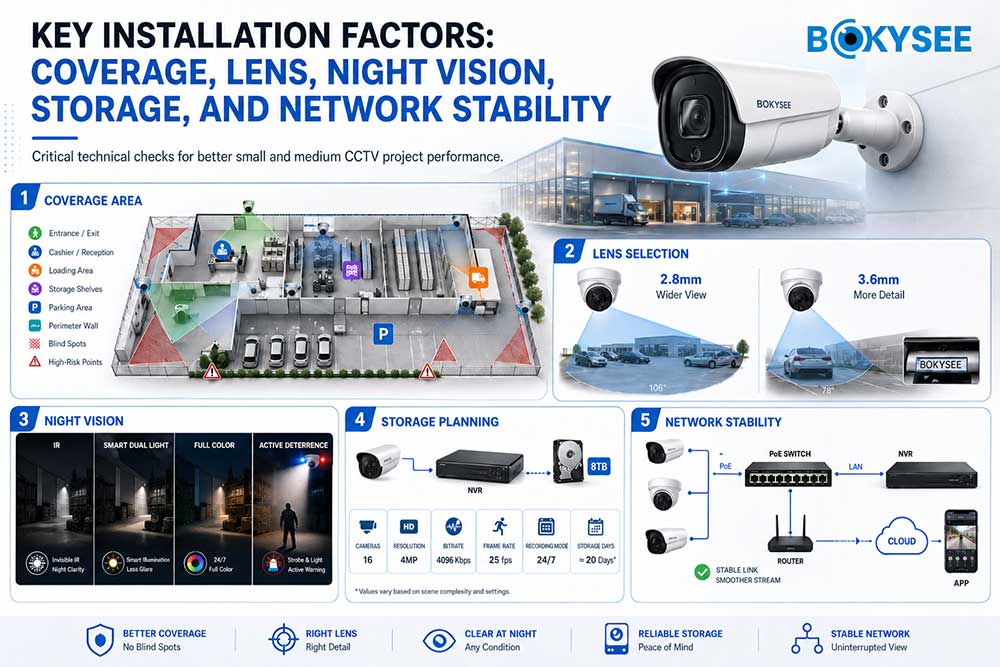
1. Coverage Area
The first question is simple: what area needs to be covered?
A small entrance, a long corridor, a large warehouse aisle, and an open parking lot require different camera choices. Before choosing a model, it is better to mark the key monitoring zones:
-
Entrance and exit
-
Cashier or reception area
-
Loading and unloading area
-
Storage shelves
-
Parking spaces
-
Perimeter wall
-
Blind spots
-
High-risk access points
This helps the installer decide how many cameras are needed and where each camera should be installed.
2. Lens Selection
Lens choice affects both viewing angle and image detail.
A wider lens can cover more area, but objects may appear smaller. A narrower lens can capture more detail at a longer distance, but the coverage area becomes smaller.
For many small and medium projects, common lens options such as 2.8mm and 3.6mm are widely used. A 2.8mm lens is often suitable for wider indoor areas or short-distance monitoring. A 3.6mm or 4mm lens may be better when the buyer needs slightly more detail at a longer distance.
For project buyers, the key is not to ask only “Which lens is better?” The better question is:
What distance and width do we need to monitor?
3. Night Vision
Night performance is one of the first things end users notice.
If a camera performs well during the day but poorly at night, the project may still fail in the customer’s eyes. For entrances, warehouses, perimeter areas, and parking lots, night image quality can be critical.
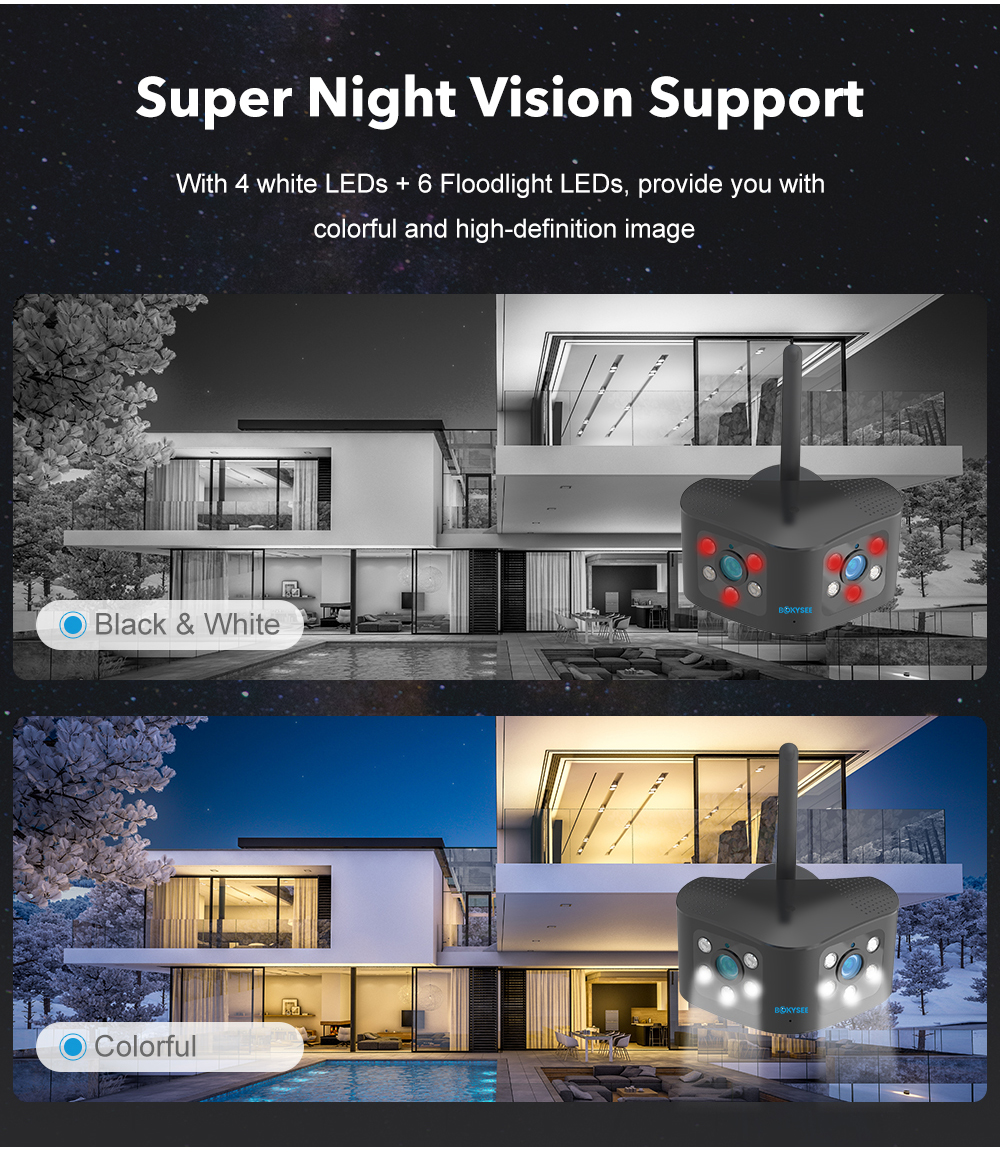
Common night vision options include:
-
IR night vision
-
Smart dual light
-
Full color night vision
-
Red and blue light active deterrence
-
Low-light image enhancement
For practical projects, smart dual light cameras can be useful because they can support normal infrared monitoring and switch to white light when needed. This helps improve color visibility and human recognition in low-light environments.
4. Storage Planning
Storage is another area that buyers often underestimate.
The required HDD capacity depends on:
-
Number of cameras
-
Resolution
-
Bitrate
-
Frame rate
-
Compression format
-
Recording mode
-
Required storage days
For example, a project with 16 cameras recording 24/7 will require a very different storage plan from a small shop with 4 cameras using motion-based recording.
That is why NVR selection should be part of camera selection from the beginning. A camera with high resolution may look attractive, but it can also increase storage demand if the bitrate is not managed well.
5. Network Stability
For IP camera projects, network stability is not optional.
A good camera still needs a stable network design. Buyers should consider:
-
Cable quality
-
PoE switch capacity
-
NVR channel support
-
Router performance
-
Distance between camera and switch
-
Bandwidth for remote viewing
-
App access requirements
For small and medium projects, simple and stable is often better than complex and difficult to maintain.
ONVIF IP Camera and NVR Compatibility: What Installers Should Check
Compatibility is one of the most important concerns for CCTV installers and system integrators.
Many buyers already have existing NVRs or prefer to use third-party systems. In this case, ONVIF support becomes important. ONVIF is an open industry forum that promotes standardized interfaces for interoperability between IP-based physical security products. In simple terms, it helps IP cameras and security systems from different suppliers communicate more easily.
But buyers should understand one important point:
ONVIF support does not mean every function will work automatically in every system.
Before bulk purchasing, installers should check:
| Compatibility Item | Why It Matters |
|---|---|
| ONVIF profile support | Helps confirm basic interoperability |
| Main stream and sub stream | Affects live view and recording performance |
| Resolution support | NVR must support the camera resolution |
| Audio support | Needed for two-way audio or sound recording |
| Motion detection support | May vary between camera and NVR brands |
| H.265/H.264 codec support | Affects storage and playback compatibility |
| App and remote viewing | Important for end-user convenience |
For project buyers, the safest method is sample testing.
Before placing a bulk order, test the camera with the actual NVR, app, network environment, and storage setup. This can reduce installation risk and avoid unnecessary disputes after delivery.
Bokysee IP camera solutions are designed with project compatibility in mind, especially for buyers who need flexible integration with different NVR systems. For installers, this means less time spent solving avoidable compatibility issues on site.
Quality, Lead Time, and Supplier Support: What B2B Buyers Should Evaluate
Camera selection is not only about the camera itself. It is also about the supplier behind the camera.
For overseas B2B buyers, a reliable CCTV camera supplier should support long-term cooperation, not just one-time product sales.
Here are the key supplier factors buyers should evaluate.
Quality Consistency
A sample may look good, but bulk order consistency matters more.
Buyers should ask:
-
Is the same chipset solution used in bulk production?
-
Are the lens, LEDs, housing, and PCBA stable?
-
Is there quality control before shipment?
-
Are aging tests or function tests performed?
-
Can the supplier provide product photos or test updates?
For installers and wholesalers, quality consistency helps reduce return rate and protect local reputation.
Lead Time Reliability
Small and medium project buyers often work with deadlines.
If the supplier delays shipment, the buyer may face project pressure from the end customer. So lead time should be confirmed clearly before ordering.
Ask about:
-
Sample lead time
-
Bulk production lead time
-
Packaging preparation time
-
OEM logo processing time
-
Shipping options
-
Peak season risks
A good supplier should communicate early if material supply, production capacity, or holiday schedules may affect delivery.
Customization Capability
Many B2B buyers need OEM or ODM support.
Common customization requests include:
-
Logo on camera housing
-
Product label
-
User manual
-
Packaging box
-
Startup screen
-
Firmware settings
-
App branding for larger projects
Not every customization request has the same MOQ or technical difficulty. A professional supplier should explain what can be done quickly, what requires higher MOQ, and what needs engineering evaluation.
Certification and Market Readiness
For overseas buyers, product certification and packaging readiness can affect import, distribution, and sales.
Buyers should check whether the supplier can support the documents and product information needed for their market, such as product specifications, packaging files, labels, and certification references.
Communication Efficiency
In B2B CCTV projects, communication speed matters.
When installers ask technical questions, they usually need practical answers, not vague marketing words. A good supplier should understand camera parameters, NVR compatibility, installation conditions, and after-sales handling.
This is one reason many buyers prefer working with CCTV manufacturers that understand both product and project needs.
CCTV Project Selection Checklist Before You Request a Quotation
Before requesting a quotation from a CCTV camera manufacturer or supplier, buyers can prepare a simple project checklist. This helps the supplier recommend suitable models faster and more accurately.
Project Information Checklist
| Question | Buyer Input |
|---|---|
| What type of project is it? | Shop, villa, warehouse, office, parking lot, construction site |
| Indoor or outdoor installation? | Indoor / outdoor / mixed |
| How many cameras are needed? | 4CH / 8CH / 16CH / 32CH / 64CH/128CH/196CH custom |
| Preferred camera type? | Bullet / dome / PTZ / WiFi / solar / kit |
| Required resolution? | 2MP / 4MP / 5MP /6MP/ 8MP |
| Night vision requirement? | IR / full color / smart dual light / alarm light |
| NVR needed? | Yes / no / already have existing NVR |
| Need ONVIF compatibility? | Yes / no |
| Need OEM branding? | Logo / label / box / firmware / app |
| Target market? | Europe / South America / Middle East / Southeast Asia |
| Expected quantity? | Sample / trial order / bulk order |
| Required delivery time? | Urgent / normal / project deadline |
This checklist allows the supplier to understand your real needs instead of only quoting the cheapest model.
For example, if you say only “I need 8 cameras,” the supplier can only guess. But if you say “I need 8 outdoor PoE cameras for a warehouse entrance and loading area, with full color night vision and NVR compatibility,” the recommendation becomes much more accurate.
This saves time for both sides.
Recommended Selection Logic for Small and Medium Projects
For most small and medium CCTV projects, Bokysee suggests using a simple selection logic:
Step 1: Define the monitoring area
Do you need to monitor people, vehicles, goods, entrances, or wide open spaces?
Step 2: Choose the camera type
Use bullet cameras for visible outdoor monitoring, dome cameras for indoor areas, PTZ cameras for wide coverage, and solar cameras for remote sites.
Step 3: Confirm image requirements
Decide the resolution, lens, night vision mode, and whether AI human or vehicle detection is needed.
Step 4: Confirm recording and storage
Choose a suitable NVR and HDD plan based on channel count, recording days, bitrate, and resolution.
Step 5: Test compatibility
If the project uses third-party NVRs or existing systems, sample testing is recommended before bulk order.
Step 6: Evaluate supplier support
Check quality control, lead time, OEM options, after-sales response, and communication efficiency.
This process helps buyers avoid the common mistake of selecting cameras only by price or resolution.
Why Buyers Should Care About Project-Fit Selection
For B2B buyers, CCTV camera selection directly affects business results.
Installers care because wrong selection increases labor cost.
System integrators care because compatibility issues create project delays.
Wholesalers care because unstable products increase return rate.
Distributors care because product quality affects local brand reputation.
Project contractors care because delivery delays can affect the full construction schedule.
End users care because they want clear video, stable recording, easy playback, and reliable security.
So the value of correct CCTV camera selection is not only technical. It is commercial.
A well-selected camera system can help buyers:
-
Reduce installation problems
-
Improve customer satisfaction
-
Lower after-sales pressure
-
Build stronger local market trust
-
Improve project delivery efficiency
-
Support long-term product sales
This is why experienced buyers do not only ask for the lowest price. They ask for the most suitable solution.
How Bokysee Supports CCTV Project Buyers
Bokysee is a CCTV security camera manufacturer and one-stop CCTV solution provider in China. We support overseas installers, distributors, system integrators, wholesalers, and project buyers with a full product range, including IP cameras, PoE cameras, PTZ cameras, smart WiFi cameras, solar battery cameras, NVRs, DVRs, and CCTV kits.
For small and medium security projects, Bokysee can help buyers select suitable models based on:
-
Project scene
-
Camera quantity
-
Installation environment
-
Resolution requirement
-
Night vision needs
-
NVR compatibility
-
Budget level
-
OEM/ODM branding needs
-
Target market demand
Our goal is not to recommend the most expensive product. Our goal is to help buyers choose products that are practical, stable, and suitable for their market.
For project buyers, this means easier product selection, better communication, and stronger long-term cooperation.
Frequently Asked Questions About CCTV Camera Selection for Projects
1. What type of CCTV camera is best for small and medium projects?
There is no single best camera for every project. The right choice depends on the site layout, installation environment, monitoring distance, night vision needs, and recording requirements.
For most small and medium projects, PoE IP cameras are a stable choice. Bullet cameras are suitable for outdoor entrances and perimeter areas, dome cameras are often used indoors, and PTZ cameras are ideal for wide areas such as parking lots, warehouses, and yards.
For remote sites without stable power or network, 4G solar cameras can be a more practical option.
2. Should installers choose PoE IP cameras or WiFi cameras?
For professional projects, PoE IP cameras are usually more reliable because they use wired network transmission. This helps reduce signal loss, video delay, and maintenance issues.
WiFi cameras are more suitable for homes, small shops, temporary monitoring points, or sites where cabling is difficult.
The key is to choose the connection method that is most stable for the actual installation site.
3. Why is ONVIF compatibility important?
ONVIF compatibility allows IP cameras to work with third-party NVRs and video management systems. This is useful when buyers already have an existing NVR or need flexible system integration.
However, sample testing is still recommended before bulk orders, because some smart functions may work differently with different NVR brands or firmware versions.
4. How many cameras does a small project usually need?
It depends on the site size and monitoring points.
A small shop may need 4–8 cameras.
A villa may need 4–16 cameras.
A warehouse or small factory may need 8–32 cameras.
A parking lot, residential area, or larger project may require more cameras and a detailed layout plan.
Before requesting a quotation, buyers should confirm key areas such as entrances, exits, corridors, storage areas, parking spaces, perimeter walls, and blind spots.
5. What resolution should buyers choose?
Common project resolutions include 2MP, 4MP, 5MP, and 8MP.
2MP is suitable for basic monitoring.
4MP and 5MP are widely used for small and medium projects because they offer better image detail while keeping storage cost reasonable.
8MP is suitable for projects that require higher image detail, but it also needs more bandwidth and storage.
The best choice should balance image clarity, storage cost, network performance, and budget.
6. Why is night vision important?
Many security incidents happen at night or in low-light environments. If the night image is unclear, the system may not help users identify people, vehicles, or events.
For entrances, warehouses, parking lots, villas, and perimeter areas, night vision performance is especially important.
Buyers can choose IR night vision, smart dual light, full-color night vision, or active deterrence cameras based on the project environment and security level.
7. What information should buyers prepare before asking for a quotation?
To get a faster and more accurate recommendation, buyers should prepare:
| Information | Why It Matters |
|---|---|
| Project type | Helps match suitable camera models |
| Indoor or outdoor use | Affects housing and waterproof requirements |
| Number of cameras | Affects NVR channels and total cost |
| Required resolution | Affects image clarity and storage |
| Night vision needs | Helps choose IR, full-color, or dual-light cameras |
| Existing NVR brand | Helps check compatibility |
| OEM branding needs | Affects logo, packaging, and MOQ |
| Target market | Helps recommend market-suitable products |
| Quantity plan | Helps calculate price and lead time |
The more details buyers provide, the more accurate the product recommendation will be.
8. How can buyers reduce risk before bulk orders?
The safest way is to test samples before mass production.
Buyers should check image quality, night vision performance, app connection, NVR compatibility, housing quality, recording and playback, long-term working stability, packaging, labeling, and supplier response speed.
Sample testing helps confirm whether the product is suitable for the project, market, and customer expectations.
9. Why choose a CCTV camera manufacturer instead of only comparing price?
Price is important, but it should not be the only factor.
For B2B buyers, the real cost also includes product quality, delivery stability, technical support, installation efficiency, return rate, and long-term cooperation risk.
A reliable CCTV camera manufacturer can provide stable supply, quality control, OEM/ODM support, packaging solutions, and more direct communication. This is especially important for installers, wholesalers, and project contractors.
10. Can Bokysee recommend cameras based on a project list?
Yes. Bokysee can help buyers select suitable IP cameras, PoE cameras, PTZ cameras, solar cameras, NVRs, and CCTV kits based on project type, camera quantity, installation environment, budget, and target market.
Buyers can send a camera list, project layout, installation photos, or basic project requirements. Bokysee will help match suitable models for wholesale, project, or OEM/ODM cooperation.
Case Study: Overseas Project Buyer Feedback
One overseas project customer needed a CCTV solution for a small-to-medium security project covering entrances, outdoor areas, and key monitoring points. The customer already had specific requirements for camera quantity, resolution, night vision performance, and NVR compatibility.
After reviewing the project list, Bokysee recommended a combination of PoE IP cameras, outdoor bullet cameras, and suitable NVR options. Before placing the bulk order, the customer tested samples to check image quality, night vision performance, app connection, ONVIF compatibility, and long-time working stability.
After testing, the customer confirmed that the camera image was clear, the wired PoE connection was stable, and the system was suitable for their local project needs. The customer also shared positive feedback on Bokysee’s product recommendation, communication speed, and technical support during the selection process.
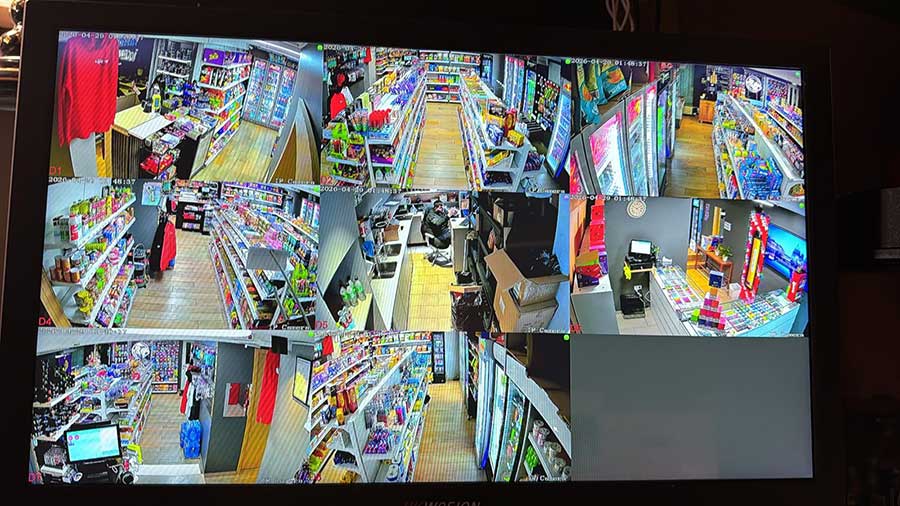
This case shows why project buyers should not only compare price. For CCTV projects, suitable model selection, sample testing, compatibility confirmation, and supplier support are all important for reducing project risk and improving long-term cooperation.
Final Thoughts
Choosing CCTV cameras for small and medium security projects should not start with price alone.
It should start with the site.
What needs to be monitored?
Where will the cameras be installed?
How clear should the image be at night?
Which NVR will be used?
How many days of recording are needed?
Can the supplier support stable delivery and after-sales service?
When buyers answer these questions clearly, camera selection becomes much easier.
A good CCTV camera selection process helps reduce project risk, improve installation efficiency, and protect long-term customer trust.
For installers, distributors, and project buyers, the best camera is not always the one with the highest specification. It is the one that fits the project, works reliably, and can be supported by a dependable supplier.
Need help selecting CCTV cameras for your next project?
Send Bokysee your project type, camera quantity, installation environment, and target market. Our team can help recommend suitable IP cameras, PTZ cameras, solar cameras, NVRs, and CCTV kits for your project or wholesale business.
See Also
Emerging IP Camera Innovations Shaping 2025 Surveillance Solutions
Ultimate Guide to 4K Security Camera Systems in 2025
Choosing Between Analog And IP Security Cameras Effectively







 English
  Spanish
  Russian