 Перейти к содержимому

A fixed camera watches one rectangle of the world and hopes the interesting part happens inside it. A PTZ-камера with auto tracking takes a different approach: it finds a moving person on its own, follows them as they cross the property, and zooms in for detail along the way — no operator, no joystick, no missed walk-offs at the edge of the frame.
The feature has moved from an expensive novelty on broadcast equipment to a checkbox item on commercial cameras. But “auto tracking” means different things on different hardware, and the gap between a demo video and a real parking lot at dusk is where most buyer disappointment lives.
It helps to look at four things: what auto tracking actually does, how the detection-and-movement pipeline works, the five factors that decide real-world accuracy, and the scenes where the technology earns its keep.
What Is PTZ Auto Tracking?
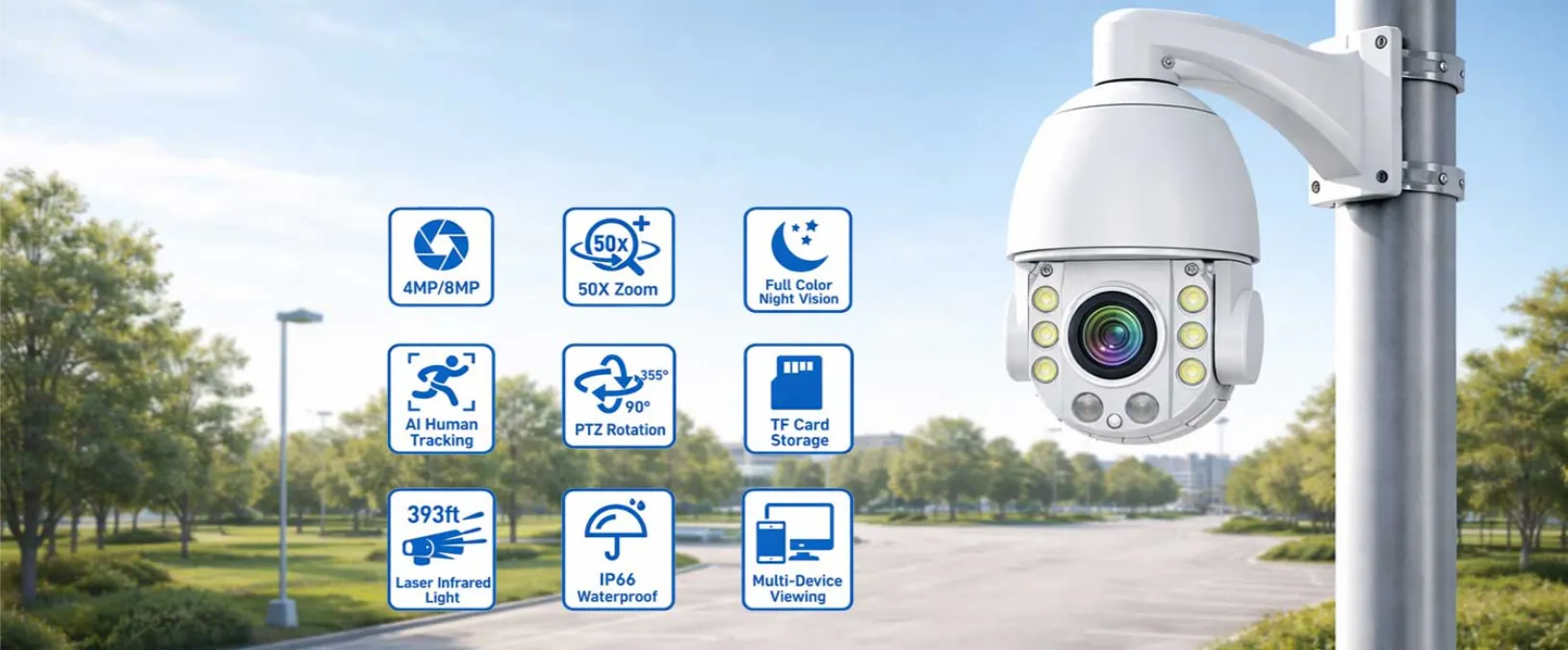
Auto tracking chains four jobs together: detect, lock, move, zoom — and the weakest link sets the ceiling.
PTZ auto tracking is a mode in which the camera’s software identifies a moving subject, selects it as a target, and drives the pan, tilt, and zoom motors to keep that subject centered in the frame. It is not one feature but a pipeline: an object-detection model finds people or vehicles in the video, a tracking algorithm maintains a lock on one target as it moves, and a motion controller translates that lock into smooth motor commands.
Because the pipeline has four stages, a camera is only as good as its weakest stage. A superb sensor with sluggish motors produces footage that lags behind the subject; fast motors paired with a weak detection model drift off target in crowds. When you evaluate auto tracking, you are evaluating the whole chain.
What Pan, Tilt, and Zoom Mean
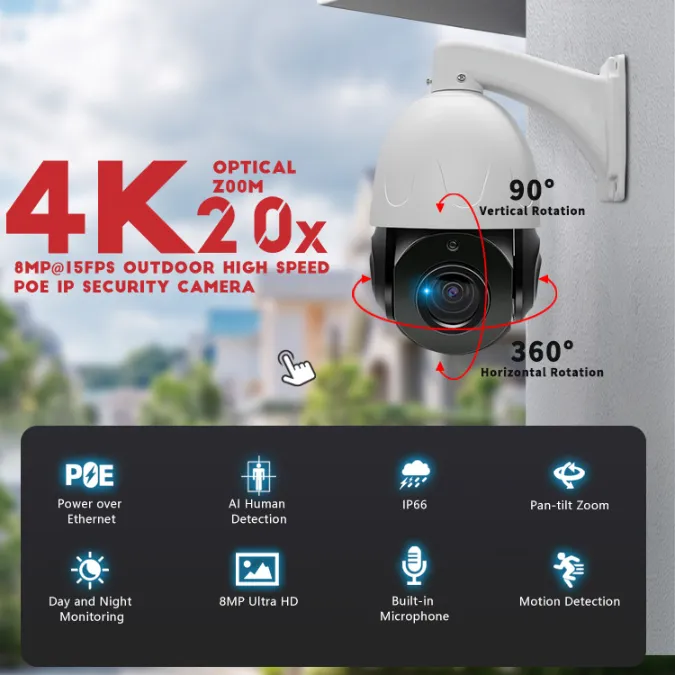
Pan sweeps the horizon, tilt covers the vertical, zoom decides how much detail survives the distance.
Pan: Sweeping the Horizon
Pan is rotation around a vertical axis,the camera turning left and right like a person scanning a parking lot. Continuous-pan models rotate through the full 360 degrees without unwinding the cable; others stop at a mechanical limit. Auto tracking leans on pan the hardest, because most subjects move horizontally through a scene.
Tilt: Covering the Vertical
Tilt is rotation around a horizontal axis, aiming the lens up and down. The typical range runs from a little below horizon to nearly straight up, which matters when a camera sits high on a pole and must look down at the ground plane where people actually walk. Tracking a subject walking toward the camera is mostly a tilt problem: the subject rises in the frame as they get closer.
Optical Zoom vs. Digital Zoom
Optical zoom moves lens elements, magnifying the image before it reaches the sensor — detail is genuinely preserved. Digital zoom crops the sensor image and enlarges the pixels, which loses detail fast beyond two or three times. For auto tracking, optical zoom is what lets a camera keep a recognizable face or license plate at 50 meters; digital zoom on top adds reach at the cost of sharpness. A fuller comparison of movement ranges and lens classes is in our guide to PTZ cameras.
| Movement | Typical Range | What It Does in Tracking |
|---|---|---|
| Кастрюля | 0–360° continuous or ±175° | follows horizontal movement |
| Наклон | −15° to +90° | follows approach and departure |
| Оптический зум | 20x–50x | keeps detail as distance grows |
| Digital zoom | 2x–16x on top | extra reach, at quality cost |
How Does a PTZ Camera Track a Moving Person?
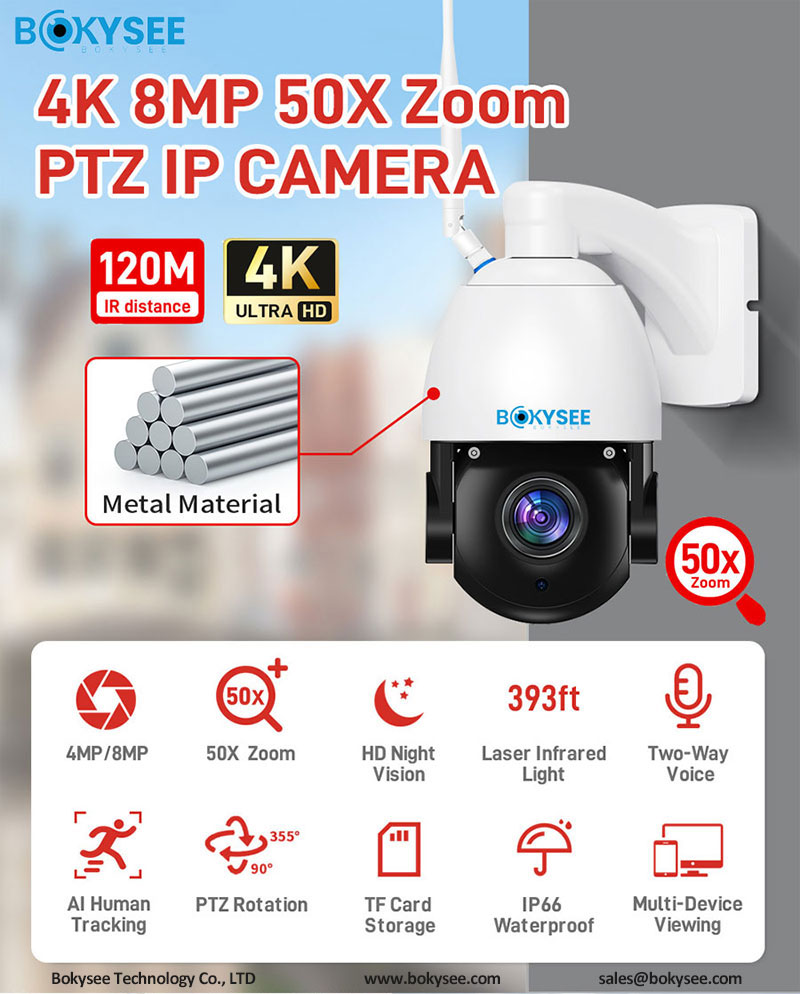
The algorithm redraws its target box many times a second while the motors chase it — smoothly is the hard part.
Under the hood, tracking a person is a loop that runs continuously. Stripped to its steps:
- Detection. The onboard model scans each frame for people or vehicles and draws a bounding box around each one.
- Target selection. The camera picks a target — typically the largest or fastest moving person in the detection zone, or the one closest to the frame center.
- Lock and follow. The tracking algorithm predicts where the target is heading and commands pan and tilt to keep it centered, updating many times per second.
- Adaptive zoom. As the subject’s box size changes with distance, the camera trims optical zoom to hold the subject at a consistent size in frame — closer means wider, farther means tighter.
- Release or re-acquire. When the subject stops moving, leaves the area, or is lost, the camera either holds its aim, returns to a preset position, or resumes scanning for the next target.
The engineering challenge is step three. Detection boxes jitter frame to frame, motors have inertia, and overshooting the target looks worse than not moving at all. Good firmware filters the jitter and eases the motors so the video reads like a skilled operator is behind the controls; cheap implementations produce the herky-jerky footage that gives auto tracking a mixed reputation.
How Accurate Is PTZ Auto Tracking?

Accuracy is not one number — it is the compound result of distance, light, speed, clutter, and mounting geometry.
Tracking Distance and Subject Size
Detection depends on the subject occupying enough pixels. At 30 meters a person fills a healthy share of the frame; at 120 meters they shrink to a handful of pixels that no model can reliably classify as a person. Auto tracking therefore has an effective detection distance — often 30 to 80 meters for person-sized targets, farther for vehicles — and zoom does not help detection, because detection runs before zoom decides what to magnify.
Lighting and Background Conditions
Daylight tracking is a solved problem on current hardware. Twilight is where models start to wobble, and IR-only night mode changes the image to grayscale, which costs detection accuracy on algorithms trained mostly on color footage. Cameras with large-aperture lenses or full-color night vision hold tracking noticeably longer into the dark. Backlight — a subject walking toward a bright sky or doorway — is a related weakness: the subject silhouettes into a shape without features.
Subject Speed and Motion Blur
Walking speed is easy; sprinting is not. Fast subjects smear across the sensor at low shutter speeds, blurring the very edges the detection model keys on, and the motors must track angular speed — a person running five meters from the camera crosses the frame far faster than a cyclist 60 meters out. Mounting height helps here: a higher vantage point turns a fast horizontal dash into a slower angular sweep.
Occlusion and Scene Complexity
When the target passes behind a truck, a column, or another person, the detection box empties and the tracker must guess: hold position and wait, or declare the target lost. Firmware quality shows exactly here — good cameras coast through short occlusions and re-acquire; weak ones latch onto whatever crossed the path instead. Crowded scenes multiply this problem, which is why auto tracking is rated for open areas rather than lobbies.
Mounting Height and Camera Angle
Mount between roughly 3.5 and 8 meters for person tracking. Too low and the camera looks at faces at close range, panning furiously as subjects pass nearby; too high and everyone becomes a small dot on the ground plane. A slight downward tilt covering the main walkways, with the camera’s home preset aimed at the highest-traffic zone, gives the tracker its best starting geometry.
Need PTZ cameras with auto tracking that performs outside the demo video? Bokysee manufactures PTZ cameras from 20x to 50x optical zoom with tuned tracking firmware, person and vehicle detection modes, and ONVIF compliance — with OEM and ODM support for your brand.
Explore OEM/ODM Solutions →Can PTZ Cameras Track People Automatically?

Yes, modern PTZ cameras track people on their own — the question is whether your scene lets them do it well.
Yes — on any current-generation PTZ camera worth buying, person tracking runs on the device itself, with no operator and no ongoing subscription. You define a detection zone, choose auto-tracking mode, and the camera handles detection, lock, movement, and zoom on its own. Most units also offer manual takeover from the app at any moment, with auto tracking resuming when you release control.
The honest caveat: “automatically” and “perfectly” are different claims. In an open yard with one or two people moving, today’s cameras hold a lock impressively well. In a busy entrance with a dozen overlapping targets, no single-target tracker — at any price — follows your chosen person flawlessly. Design for the former, or plan a multi-camera layout for the latter.
When Should You Use PTZ Auto Tracking?
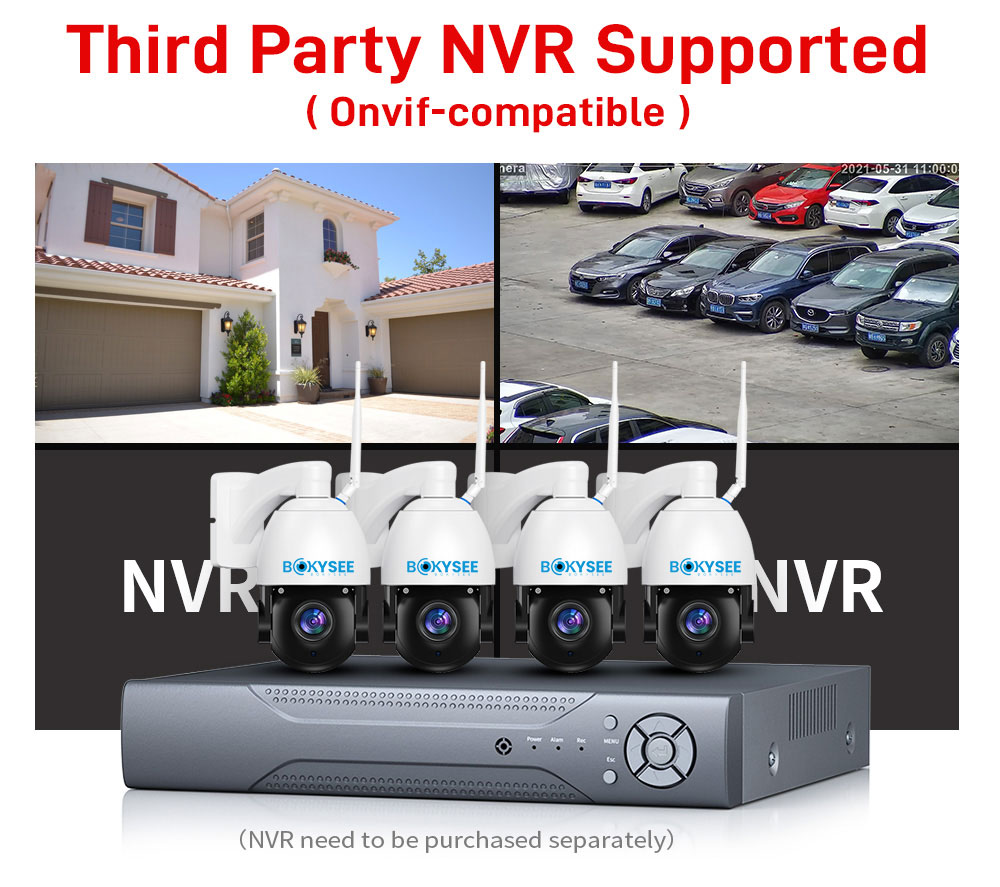
Auto tracking shines where a subject must be followed across open ground — not in crowded, tight, or cluttered scenes.
| Scene | Fit for Auto Tracking | Почему |
|---|---|---|
| Perimeters, fences, open yards | strong | few targets, long sightlines, exactly what tracking was built for |
| Parking lots and driveways | strong | person and vehicle modes both apply; zoom covers plate-level detail |
| Warehouse aisles and docks | moderate | works well when traffic is sparse; racking creates occlusions |
| Entrances, lobbies, retail floors | weak | crowded scenes defeat single-target tracking; fixed cameras fit better |
A practical rule from the installer side: use auto tracking to substitute for several fixed cameras across open ground, not to replace coverage of choke points. A gate, door, or register still deserves a dedicated fixed camera with a guaranteed frame; the PTZ camera handles the wide, unpredictable space around it. For how these trade-offs interact with network choices, our comparison of PoE and WiFi cameras for installers covers the cabling side, and integrators building mixed systems should confirm each model’s conformance with the ONVIF profile for PTZ interoperability.
Frequently Asked Questions About PTZ Auto Tracking
Can a PTZ camera track more than one person?
Most PTZ cameras in the commercial range track a single target at a time — usually the largest or closest person in the detection zone. When a second person crosses the path, the camera either holds its lock or switches targets depending on firmware. True multi-target tracking exists on high-end systems, which hand targets off between several coordinated cameras.
Can PTZ cameras track vehicles automatically?
Yes, on models with a vehicle-detection mode. Vehicles are in some ways easier targets than people — larger, faster, more predictable paths — but the camera needs enough optical zoom range and a mounting height that keeps the vehicle in frame as it crosses the scene.
Why does a PTZ camera sometimes lose its target?
Common causes: the subject passes behind an obstacle, another person or vehicle crosses between the camera and the target, the subject leaves the frame faster than the motors can follow, or lighting shifts — headlights at night, shadows at dusk — confuse the detection model.
Does PTZ auto tracking work through glass?
Poorly. Glass reflects the camera’s own image back at the sensor, filters the infrared light that helps detection, and can throw off autofocus. If mounting behind a window is unavoidable, disable IR, angle the camera slightly off-perpendicular to reduce reflection, and expect reduced tracking performance.
Can PTZ auto tracking work in low-light conditions?
It depends on the sensor. Cameras with large-aperture lenses or full-color night vision keep detection working down to very low light levels; IR-only cameras switch to grayscale, where detection models lose accuracy. Deep darkness affects tracking earlier than it affects recording.
Does auto tracking affect the camera’s recording quality?
No. Tracking changes where the camera points, not how it records — resolution and compression stay the same. Two minor caveats: fast pans at low shutter speeds introduce slight motion blur in frames, and continuous movement nudges bitrate upward on the encoded stream.
Заключительные мысли
PTZ auto tracking is not magic and it is not marketing — it is a four-stage pipeline of detection, lock, motor control, and zoom that performs brilliantly in open scenes with clear sightlines and degrades predictably in crowded, occluded, or badly mounted ones. Knowing which side of that line your site falls on is most of the buying decision.
Spec the camera for your worst realistic night, not the vendor’s best demo day: check the sensor’s low-light class, confirm the optical zoom range matches the distances you actually need to cover, and mount at the height that gives the tracker room to work.
If you are building a product line around smart surveillance, Бокизее manufactures PTZ cameras with tuned auto-tracking firmware and person/vehicle detection — with OEM and ODM customization from housing to model behavior.






 Russian
  English
  Spanish