 Skip to content
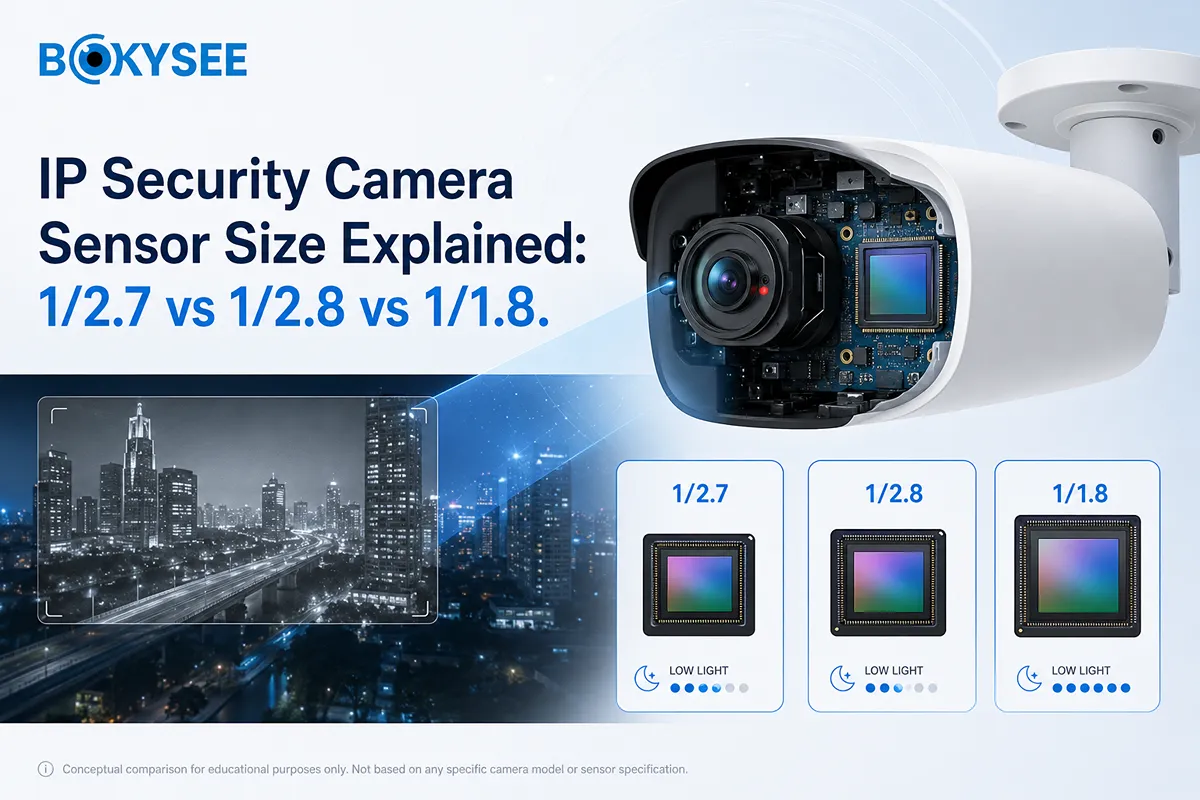
Quick Answer: Which IP Security Camera Sensor Size Is Best for Low Light?
A larger image sensor generally offers more light-collecting area and can provide stronger low-light potential when resolution, pixel design, lens, exposure and image processing are comparable. A 1/1.8-type sensor is generally larger than a 1/2.8-type or 1/2.7-type sensor.
Sensor size alone does not determine night quality. Buyers must also compare pixel size, sensor generation, lens aperture, shutter speed, WDR, noise reduction, infrared or white-light illumination and the image signal processor. Start with the Bokysee IP security camera range and request original day and night footage from the exact sensor, lens and firmware configuration.
What Does 1/2.7, 1/2.8 or 1/1.8 IP Security Camera Sensor Size Mean?
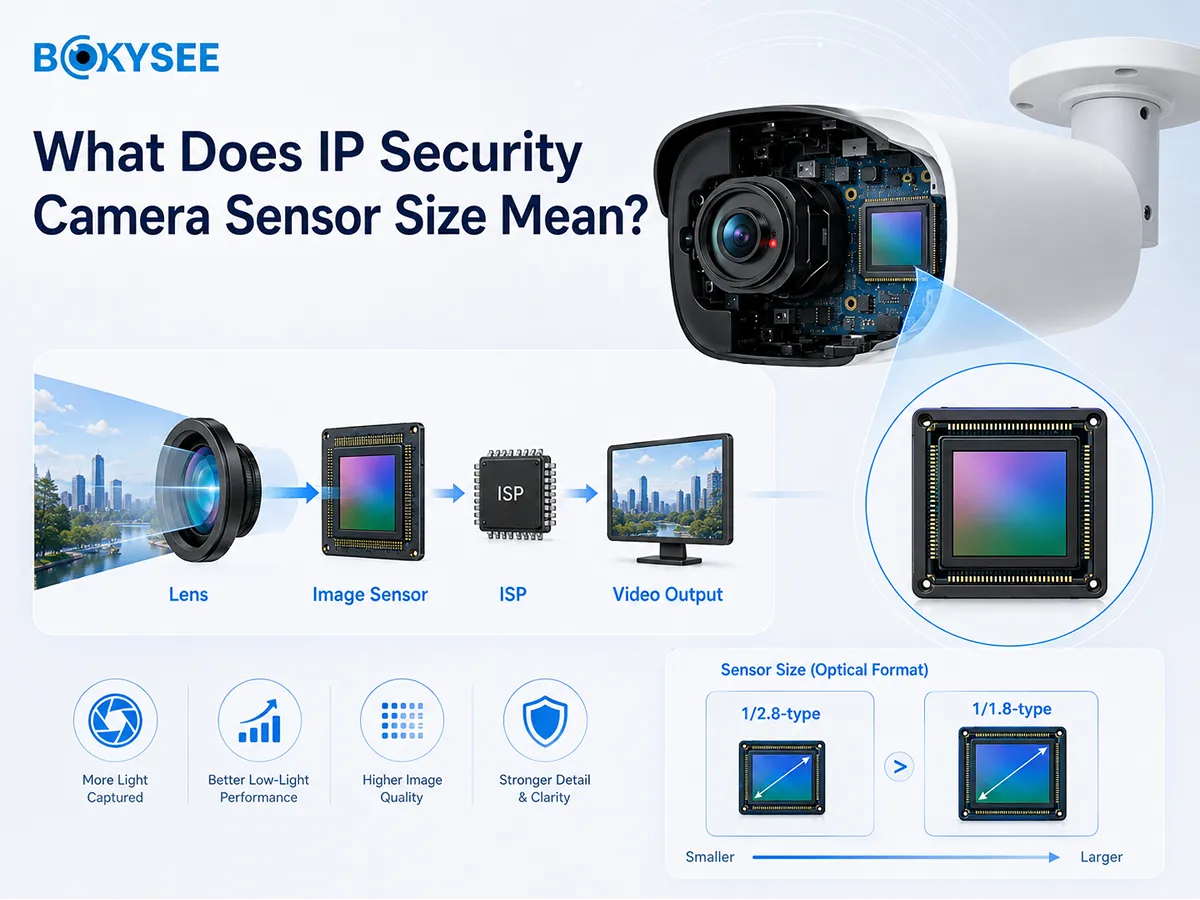
The image sensor converts light entering the lens into the electronic signal used to create video. Common optical formats include:
· 1/3-type
· 1/2.9-type
· 1/2.8-type
· 1/2.7-type
· 1/2.5-type
· 1/1.8-type
The naming is an optical-format convention, not the exact physical diagonal of the active area. In general, a smaller denominator means a larger format. Therefore, 1/1.8-type is larger than 1/2.8-type.
Active dimensions vary by sensor model and aspect ratio, so request the exact manufacturer and model rather than accepting only “1/2.8 CMOS.” Sony’s official security camera image sensor portfolio lets users compare image size, resolution, pixel size, frame rate and HDR functions.
1/2.7 vs 1/2.8 vs 1/1.8 IP Security Camera Sensor Comparison
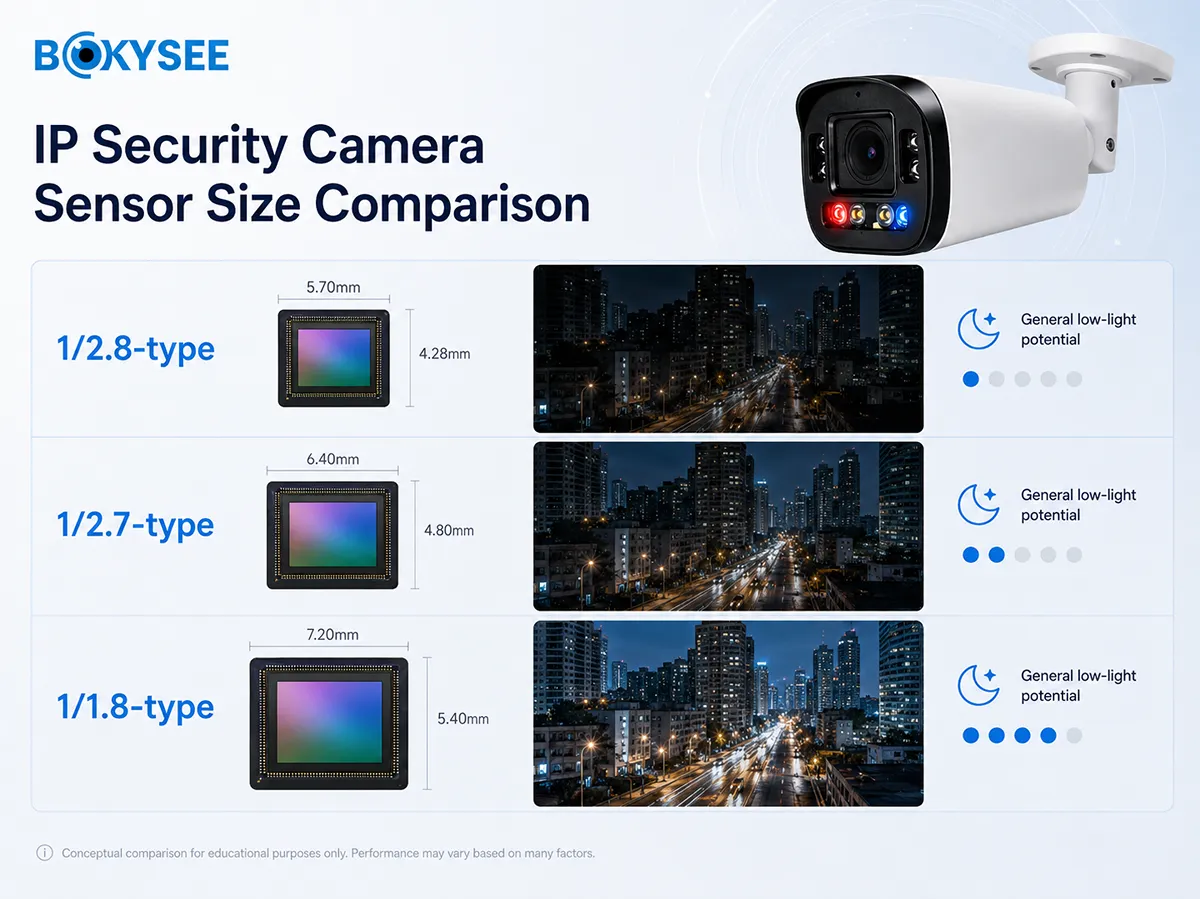
| Sensor Format | Relative Size | Common Strength | Possible Trade-Off | Typical Positioning |
| 1/2.8-type | Mainstream | Balanced size, cost and resolution | Low-light result depends on pixel design and lens | General 2MP-8MP PoE cameras |
| 1/2.7-type | Similar mainstream class | Flexible for commercial cameras | Format label alone proves little | Residential and commercial CCTV |
| 1/1.8-type | Larger | Stronger low-light and WDR potential | Higher cost and larger lens requirements | Premium low-light and 4K projects |
A modern 1/2.8-type sensor can outperform an older or poorly implemented larger sensor. Conversely, a high-quality 1/1.8 design may provide a clear advantage in difficult lighting. Compare complete cameras, not isolated format labels.
How IP Security Camera Sensor Size Affects Low-Light Image Quality
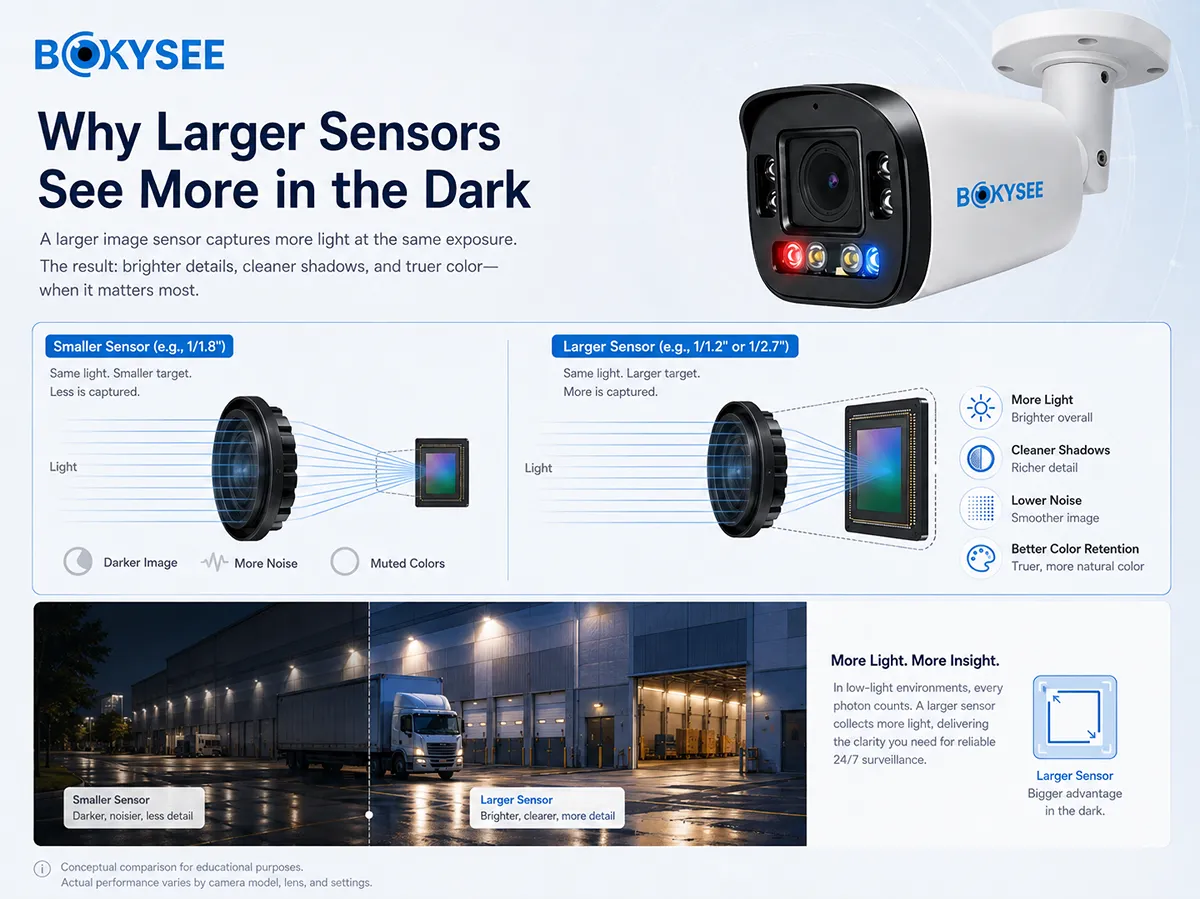
A larger sensor provides more total light-collecting area and may improve brightness, signal-to-noise ratio, shadow detail, color retention and dynamic range when the remaining design is comparable.
However, a camera can look artificially bright by using a slow shutter, high gain and strong noise reduction. A static screenshot may look attractive while a moving person becomes blurred or ghosted. Low-light comparisons should therefore include motion at the required distance.
Sony’s STARVIS security camera sensor technology overview highlights low-noise, high-sensitivity and wide-dynamic-range performance as important security-imaging requirements.
IP Security Camera Sensor Size vs Pixel Size: What Is the Difference?
Sensor size describes the overall imaging area. Pixel size describes the dimensions of each photosite. Both matter.
With similar resolution and technology, a larger sensor may use larger pixels and collect more light per exposure. With the same sensor size, a 4MP design may have larger pixels while an 8MP design provides more spatial detail in good light.
Choose according to the scene:
· 8MP can support long-distance digital zoom when lighting and lens quality are sufficient.
· A well-designed 4MP camera may preserve cleaner low-light motion.
· A premium project that needs both high resolution and strong night quality may require a larger sensor, better lens and stronger ISP.
The EMVA 1288 camera characterization standard defines methods for measuring sensitivity, noise and other performance parameters. Its main lesson for buyers is that objective conditions are more useful than vague marketing claims.
Why More Megapixels Do Not Always Improve IP Security Camera Night Vision
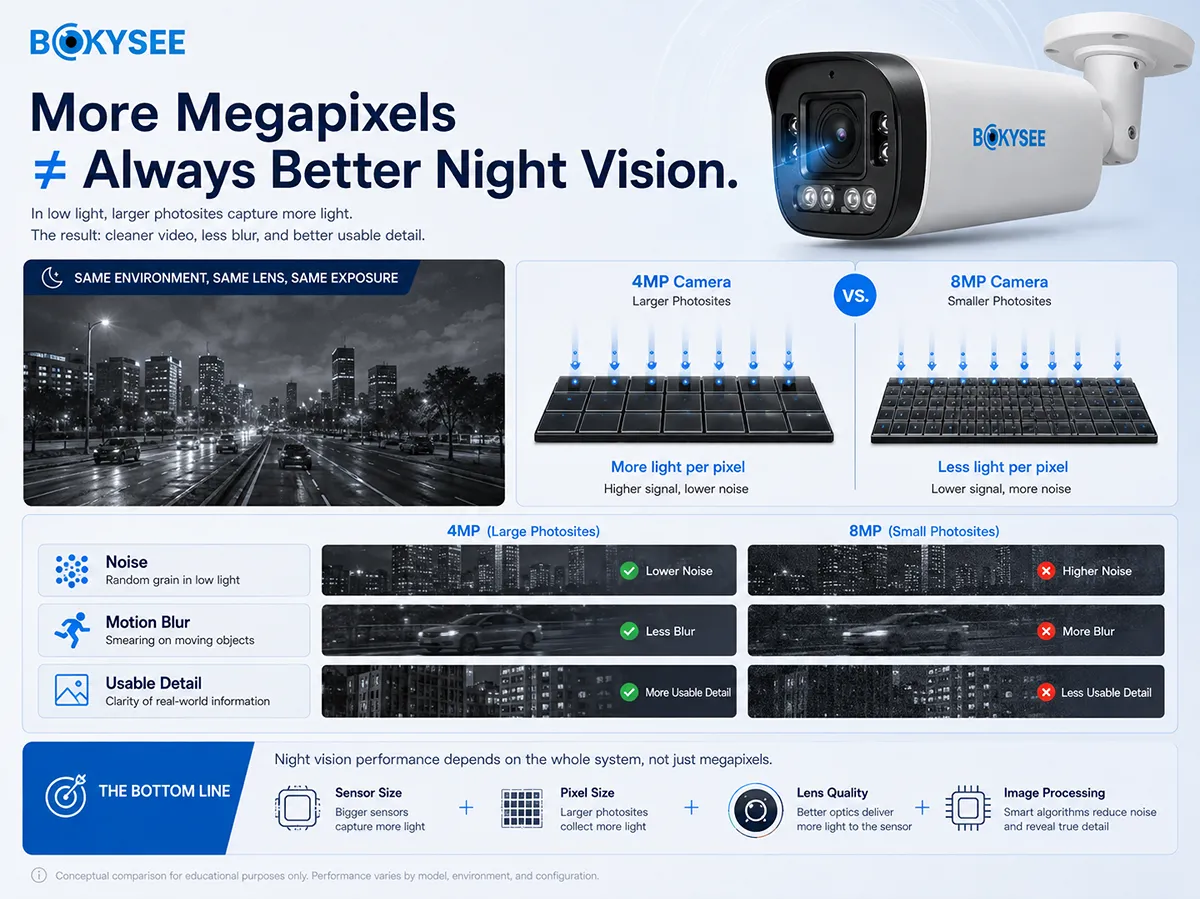
Megapixels describe pixel count, not usable detail in every condition. High resolution needs a sharp lens, accurate focus, sufficient bitrate, suitable shutter speed and effective noise control.
A high-megapixel camera can perform poorly when:
· Pixels are small and the scene is dark
· Gain creates heavy noise
· Noise reduction removes facial texture
· Shutter speed is too slow for moving people
· The lens is soft at the edges
· Bitrate is too low for the resolution
· Infrared reflection overexposes nearby objects
A well-designed 4MP low-light camera can therefore provide more useful night evidence than a low-cost 8MP camera. The 8MP model may still have a clear advantage in good light.
The Bokysee 4MP vs 5MP vs 8MP security camera guide compares resolution, bitrate and project use.
How Lens Aperture and Focal Length Affect IP Security Camera Sensor Performance
The sensor can only use the light delivered by the lens. A larger sensor paired with a slow or unsuitable lens may not achieve its potential.
Lens aperture for low-light IP security cameras
A wider aperture allows more light to reach the sensor. Aperture also affects depth of field, lens size, cost and edge performance. The quoted F-number should be evaluated with image sharpness and focus stability.
Focal length and field of view
Focal length determines coverage and target size. A 2.8 mm lens covers a wider area but provides fewer pixels across a distant face. A 6 mm or 12 mm lens provides a narrower view with more detail at distance.
Sensor size also changes the field of view from a given lens. The Bokysee security camera lens focal length guide explains 2.8 mm, 4 mm, 6 mm and 12 mm options.
Lens image circle and sensor matching
The lens must cover the sensor area. A lens designed for a smaller format may create dark corners, reduced edge sharpness or cropping. For a 1/1.8-type sensor, confirm that the lens supports the required image circle and resolution.
How Shutter Speed, Gain and ISP Change Low-Light IP Camera Results
A slow shutter brightens the image but increases motion blur. Electronic gain amplifies both signal and noise. Strong noise reduction can remove facial texture or leave ghost trails. WDR can balance entrances and headlights but may also increase noise.
The ISP controls exposure, color, sharpening, HDR and noise reduction. Two cameras using the same sensor can therefore produce different results because of firmware and tuning.
Sony’s IMX908 security camera sensor page is an example of a compact 1/2.8-type 8.4MP sensor designed for HDR and low-light monitoring. It demonstrates that modern pixel architecture can improve performance within a smaller format.
Which IP Security Camera Sensor Size Fits Each Application?
| Application | Practical Sensor Direction | Other Critical Factors |
| Home and small retail | Good mainstream 1/2.8 or 1/2.7 design | Lens, dual light and correct exposure |
| Warehouse and factory | Mainstream for general zones; higher sensitivity for dark entrances | WDR, mounting and target distance |
| Parking and perimeter | Larger or premium low-light design where justified | Shutter, focal length and IR control |
| Full-color night vision | Sensitive sensor with ambient or white light | Aperture, ISP and light pollution |
| Premium 4K project | Larger format may support resolution plus low light | Matching lens, bitrate, NVR and storage |
The Bokysee full-color vs dual-light IP security camera guide explains ultra-low-light full-color and smart IR-plus-white-light operation.
How to Test IP Security Camera Sensors Under Real Project Conditions
Use the same camera position, target distance, ambient light, focal length, aperture, shutter, FPS, bitrate and illumination mode.
Daytime sensor test
Compare:
· Center and corner sharpness
· Color accuracy
· WDR against doors or windows
· Moving-person detail
· Digital zoom
· Focus consistency
Low-light sensor test
Compare:
· Face and clothing detail
· Motion blur
· Color retention
· Noise and ghosting
· Headlight control
· Overexposure near the camera
· Dark corners
· Compression artifacts
Request original files and settings screenshots. Social-media video may be recompressed and should not be the only evidence. A fair night test must include a moving person or vehicle because a static bright image can hide slow-shutter blur.
IP Security Camera Sensor Procurement Checklist for OEM Buyers
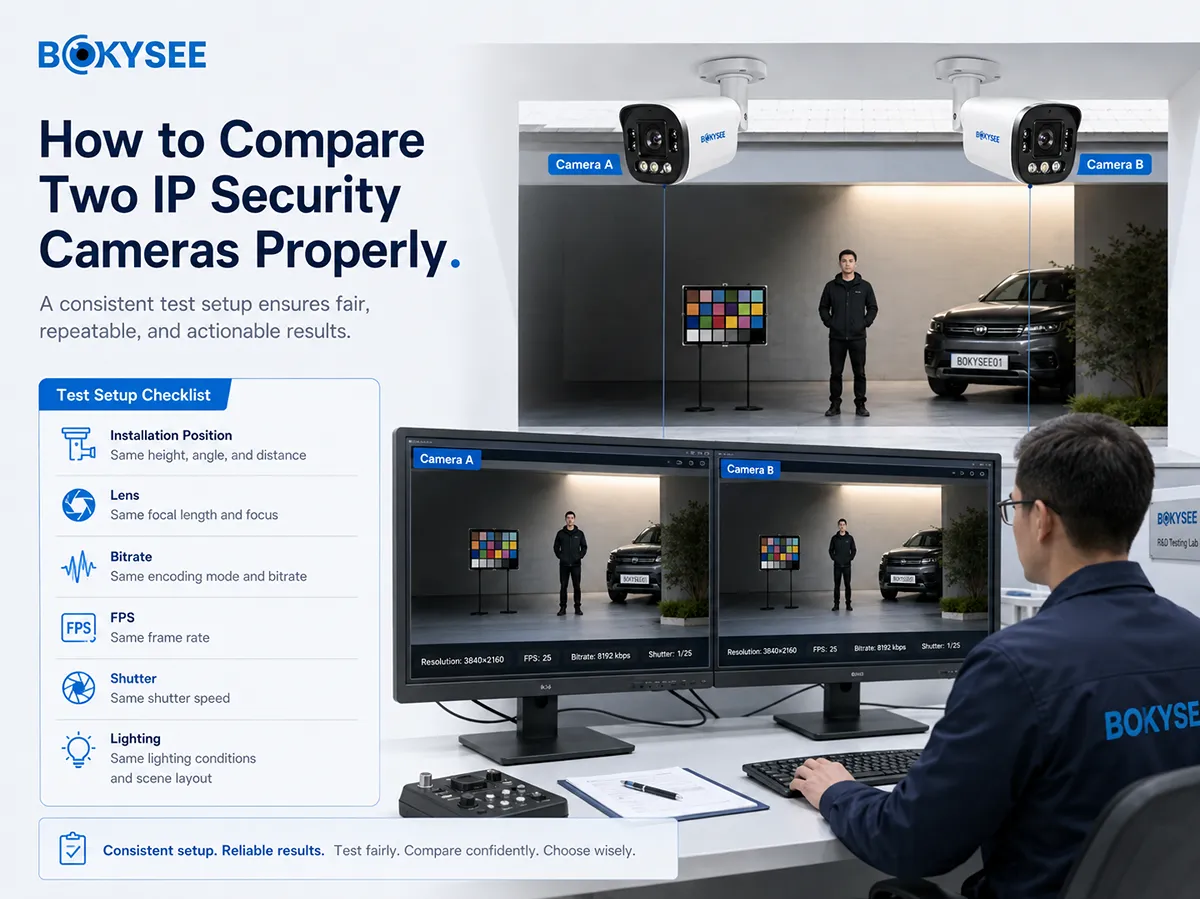
| Specification | Buyer Verification |
| Sensor manufacturer and model | Confirm the exact component, not only “CMOS” |
| Optical format | 1/2.8, 1/2.7, 1/1.8 or other |
| Effective resolution | Confirm native sensor and output resolution |
| Pixel size | Request where available |
| Lens format and aperture | Confirm compatibility with sensor size |
| Minimum illumination | Check shutter and test conditions |
| WDR method | Digital WDR, multi-exposure HDR or other |
| Shutter range | Check motion performance at night |
| IR and white-light distance | Validate with outdoor footage |
| Codec and bitrate | Ensure recording retains sensor detail |
| NVR compatibility | Test main stream, sub stream and playback |
| Original samples | Keep approved day and night files |
For OEM projects, approve the sensor, lens, ISP platform and firmware combination because any change can alter image quality.
Buyers can review an 8MP PoE IP security camera for commercial projects and request sensor details, original footage and sample testing.
IP Security Camera Sensor Size FAQ
Is a 1/1.8 sensor always better than a 1/2.8 sensor?
No. It is larger and may have stronger low-light potential, but sensor generation, lens, ISP and settings determine the final result.
Is a 1/2.7 sensor larger than a 1/2.8 sensor?
They are close optical-format categories. Check the exact active dimensions and sensor model.
Can an 8MP IP camera have worse night vision than a 4MP camera?
Yes. A poorly designed 8MP camera may show more noise or blur than a well-designed 4MP low-light camera.
Which sensor size is best for full-color night vision?
A larger or more sensitive sensor can help, but full-color imaging also needs a suitable lens, ISP, shutter and visible light.
Should distributors request the image sensor model?
Yes. The exact model, lens and original footage provide more purchasing value than megapixel count alone.
Final Recommendation: Compare the Complete IP Security Camera Imaging Chain
Evaluate the complete chain: sensor, pixels, lens, aperture, shutter, ISP, illumination, codec, bitrate and recorder. Real footage should be tested before bulk production.
Bokysee can help distributors, installers and OEM buyers select a suitable low-light IP security camera solution according to resolution, night environment, target distance, lens and NVR platform.







 English
  Spanish
  Russian