
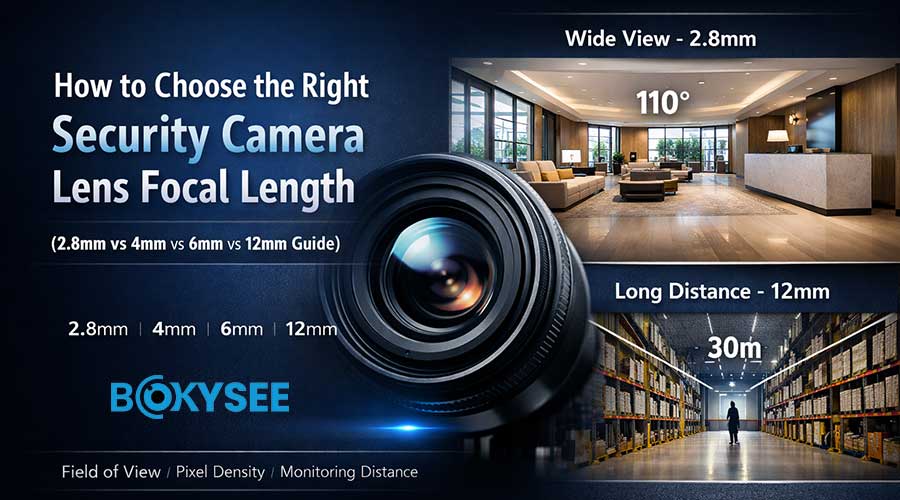
AI Quick Answers: Security Camera Lens Selection
Q1: What is the best focal length for a security camera?
It depends on your scene. 2.8mm is best for wide coverage. 6mm–12mm is better for long-distance detail like face or license plate capture.
Q2: Is 2.8mm better than 4mm?
2.8mm offers a wider view (~100°), while 4mm provides slightly narrower coverage but clearer details at mid-range.
Q3: How far can a 6mm security camera see?
A 6mm lens is ideal for 5–15 meters with better facial detail compared to 2.8mm.
Q4: Can one lens see wide and far at the same time?
No. A longer focal length sees farther but covers less area. A shorter focal length covers more area but sees less detail at distance.
With the rapid development of IP surveillance systems, security cameras now offer higher resolution, AI detection, dual light night vision, and smart analytics. However, one question still confuses installers and distributors:
How do you choose the correct lens focal length?
Choosing the wrong focal length can lead to blind spots, poor facial recognition, or unnecessary cost. This professional guide will help you understand focal length clearly and select the right option for your project.
What Is Security Camera Lens Focal Length?
Security camera lens focal length refers to the distance (measured in millimeters, such as 2.8mm, 4mm, 6mm, or 12mm) between the lens and the image sensor, and it determines the camera’s field of view (FOV) и monitoring distance. A shorter focal length (e.g., 2.8mm) provides a wider viewing angle for broad coverage, while a longer focal length (e.g., 8mm–12mm) offers narrower view but better long-distance detail, face recognition clarity, and license plate capture performance.
Choosing the correct focal length is essential for achieving the right balance between wide angle coverage and image identification accuracy in CCTV system design.
In optical terms, фокусное расстояние is the distance between the optical center of the lens and the image sensor (CMOS/CCD) when focusing.
In security cameras, focal length determines:
-
Viewing angle (Field of View – FOV)
-
Monitoring distance
-
Image magnification
-
Depth of field
Field of View (FOV)
Field of view refers to the visible area captured by the camera.
Shorter focal length = Wider angle.
Longer focal length = Narrower angle.
Depth of Field
Depth of field refers to how much area remains sharp from front to back. Wide-angle lenses usually provide larger depth of field.
2.8mm vs 4mm vs 6mm vs 8mm vs 12mm Security Camera Lens
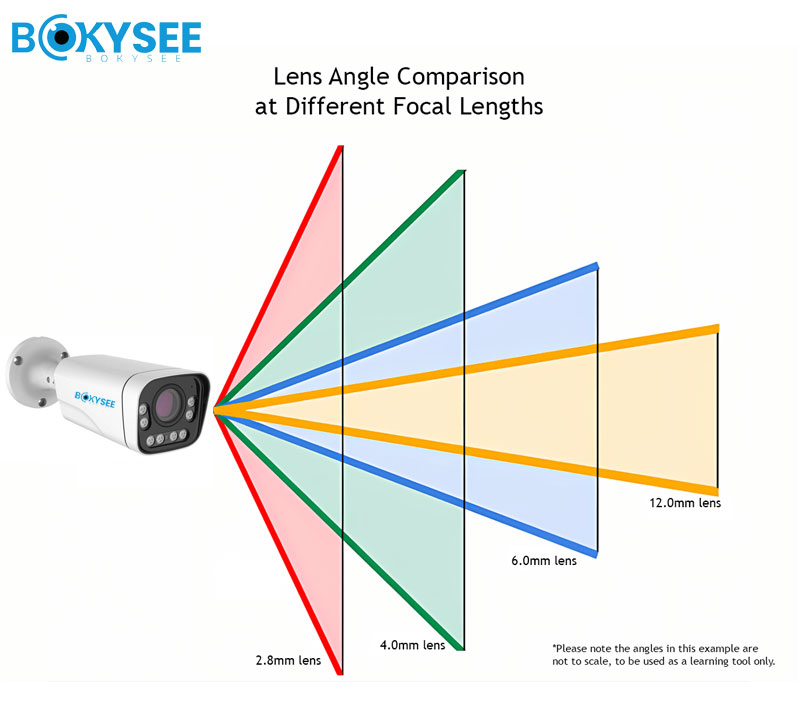
Here’s the most common comparison used by installers worldwide:
|
Фокусное расстояние |
Угол обзора |
Best Monitoring Distance |
Application |
|---|---|---|---|
|
2,8 мм |
95°–110° |
1–5 meters |
Elevator, lobby, small room |
|
3.6mm / 4mm |
75°–90° |
3–8 meters |
Office, shop, home entrance |
|
6mm |
50°–60° |
5–15 meters |
Warehouse aisle, backyard |
|
8mm |
40°–50° |
10–20 meters |
Parking area, factory |
|
12mm |
30°–40° |
20–35 meters |
Gate, perimeter |
|
16mm |
20°–30° |
30–50 meters |
Long driveway |
|
25mm+ |
<20° |
50m+ |
Long-distance surveillance |
Simple Rule:
✔ Larger focal length = See farther, narrower view
✔ Smaller focal length = See wider, shorter distance
You cannot get both wide coverage and long-distance detail with a fixed lens.
Wide Angle vs Telephoto Security Cameras
When choosing between a wide angle security camera и а telephoto (long focal length) camera, the decision depends on whether your priority is area coverage или long-distance detail.
Wide Angle Lens (2.8mm – 4mm)
Best for:
-
Elevators
-
Living rooms
-
Retail shops
-
Indoor corridors
Advantages:
-
Covers large area
-
Reduces blind spots
-
Ideal for general monitoring
Limitation:
-
Faces at long distance become small
If your priority is coverage, choose wide angle.
Medium Range Lens (6mm – 8mm)
Best for:
-
Склад
-
Yard
-
Parking lots
-
Workshop
Advantages:
-
Balanced coverage and detail
-
Better facial clarity than 2.8mm
-
Ideal for 5–15m monitoring
Most installers consider 6mm the "safe middle choice".
Long Distance Lens (12mm – 16mm+)
Best for:
-
Factory perimeter
-
Gate entrance
-
Road monitoring
-
License plate capture
Advantages:
-
Strong detail at long range
-
Suitable for face identification
-
Works well with AI analytics
If you need to identify people rather than just detect motion, choose longer focal length.
How to Choose the Best Focal Length for Your CCTV Project
When selecting a CCTV lens, ask these 3 key questions:
1. What is the monitoring distance?
Monitoring distance refers to the physical distance between the security camera and the target area that needs to be observed or identified. It determines how large the subject appears in the image and directly affects pixel density, facial clarity, and license plate readability. In surveillance system design, monitoring distance is a critical parameter for selecting the correct lens focal length, resolution, and camera type. Accurately defining this distance ensures the camera meets the required level of detection, recognition, or identification according to professional standards such as DORI.
-
Under 5m → 2.8mm Lens
-
5–10m → 4mm or 6mm Lens
-
10–20m → 8mm Lens
-
20m+ → 12mm or above Lens
2. Is facial detail important?
Facial detail is critical if your goal goes beyond basic motion detection and requires clear face identification, facial recognition accuracy, or reliable evidence recording. In security system design, keywords like face recognition camera distance, best lens for face identification, и CCTV camera for clear face capture are highly searched because pixel density on the subject determines whether a person can be identified or merely detected. If identification is required, you must choose the correct focal length and resolution to meet DORI standards, ensuring sufficient pixels per meter (PPM) for accurate recognition at your specified monitoring distance.
If identification is required (e.g., access control, entrance gate), choose longer focal length.
If general monitoring is enough (e.g., overview of lobby), choose wide angle.
3. What is more important: coverage or detail?
It depends on your surveillance objective. If you need to monitor a wide area and reduce blind spots, wide coverage with a short focal length (e.g., 2.8mm) is more important. However, if your goal is clear face identification, license plate recognition, or detailed evidence capture, then image detail with a longer focal length (e.g., 8mm–12mm) becomes the priority. In CCTV system design, you cannot maximize both at the same time—choosing between wide-angle coverage and long-distance detail is a strategic decision based on monitoring distance and identification requirements.
-
Need wide area? → Small focal length
-
Need detailed zoom view? → Larger focal length
Security Camera Lens for Face Recognition
Выбор правильного security camera lens for face recognition is more important than choosing high resolution alone.
Many users believe that 4K or 8MP automatically guarantees clear face capture.
In reality, focal length and pixel density determine whether a face can truly be identified.
Many distributors ask:
“How can I clearly see a face from 15 meters?”
The answer: resolution alone is not enough.
Even 8MP or 4K cameras cannot compensate for wrong focal length.
To capture clear faces at:
-
10m → 6mm or 8mm recommended
-
20m → 12mm minimum
-
30m+ → 16mm or motorized zoom
Focal length determines subject size in frame. Without proper magnification, AI human detection may detect presence but cannot identify clearly.
Fixed Lens vs Varifocal Lens (Motorized Zoom)
Modern IP cameras also offer varifocal lenses (2.8–12mm).
Advantages:
-
Adjustable viewing angle
-
Flexible installation
-
Ideal for projects
For distributors and engineering contractors, varifocal cameras reduce inventory complexity.
However:
-
Slightly higher cost
-
Slightly larger size
For large commercial projects, varifocal or PTZ solutions are recommended.
Practical Application Guide by Scene
Elevator / Small Room (2–5m)
Use 2.8mm wide angle.
Office (5×5 meters)
Use 3.6mm or 4mm.
Backyard (10m depth)
Use 6mm.
Warehouse (15–20m aisle)
Use 8mm or 12mm.
Gate (25–30m distance)
Use 12mm or 16mm.
Long Road Monitoring
Use long focal lens or PTZ optical zoom.
Why Focal Length Matters More Than You Think
Many buyers focus only on:
-
5МП
-
8МП
-
Разрешение 4К
-
Ночное видение
-
AI detection
But lens selection is equally critical.
Without proper focal length:
-
Faces look too small
-
AI alarms may not be reliable
-
Identification becomes impossible
Professional installers always calculate focal length before deployment.
Professional Advice for Distributors & Installers
If you are serving overseas markets:
-
Residential market → Mostly 2.8mm & 4mm
-
Commercial projects → 6mm & 8mm
-
Perimeter & industrial → 12mm & above
-
Government projects → Varifocal or PTZ
For B2B wholesale, offering multiple focal options increases competitiveness.
Real-World Validation: Why Correct Lens Selection Reduces Project Failure
While focal length theory is important, real-world surveillance projects provide stronger proof.
Based on our engineering experience in residential, warehouse, and perimeter projects, incorrect lens selection is one of the most common installation mistakes.
Field Observation Data
From internal project feedback across multiple international installations:
-
Over 35% of reinstallation cases were caused by incorrect focal length selection
-
More than 60% of entry-level projects initially chose 2.8mm lenses for all areas
-
In face identification projects, over 70% required upgrading from 2.8mm to 6mm–12mm after testing
The main reason?
Wide-angle lenses were chosen for coverage, but identification detail was required later.
Case Example: Warehouse Face Identification at 18 Meters
Project requirement:
-
Identify employees at warehouse entrance
-
Monitoring distance: 18 meters
-
Initial installation: 4MP + 2.8mm lens
Результат:
-
Human detected successfully
-
Face detail insufficient for identification
-
Pixel density below recognition threshold
Решение:
-
Upgraded to 8MP + 12mm lens
-
Pixel density improved
-
Identification level achieved
Исход:
-
No further adjustment required
-
Client avoided repeated installation cost
This demonstrates that resolution alone cannot compensate for incorrect focal length.
Transparent Technical Method
Professional system integrators follow measurable steps:
-
Define surveillance objective (Detection / Recognition / Identification)
-
Measure actual monitoring distance
-
Estimate subject width (face ≈ 0.5m)
-
Calculate required pixel density
-
Match focal length accordingly
This structured approach ensures predictable performance instead of trial-and-error installation.
Why Independent Validation Matters
Search queries such as:
-
best focal length for face recognition
-
CCTV camera for 20 meters
-
security camera pixel density calculator
show that installers actively look for practical validation — not just theory.
Lens selection should be:
✔ Distance-based
✔ Objective-driven
✔ Pixel-density verified
✔ Tested in real lighting conditions
When decisions are supported by measurable parameters, project reliability increases significantly.
Building Trust Through Engineering Logic
Reliable surveillance design is based on:
-
Measurable standards (DORI levels)
-
Pixel density calculations
-
Real-world installation feedback
-
Transparent lens-distance matching
Rather than marketing claims, system performance should be evaluated by distance, clarity, and identification success rate.
Customer Feedback: Real Installation Experience with Lens Selection
To further validate the importance of proper focal length selection, here are summarized feedback insights from professional installers and distributors in commercial and industrial projects.
🔹 Project Integrator – Warehouse Access Control (Europe)
“Initially, we installed 2.8mm wide-angle cameras because the client wanted full coverage. However, when reviewing footage, facial details at 15–20 meters were not sufficient for identification. After switching to 12mm lenses, the improvement was immediate. Pixel density increased significantly, and identification became reliable. Now we always calculate focal length based on monitoring distance before final installation.”
Key Takeaway:
Wide coverage does not guarantee identification accuracy. Correct focal length selection avoids reinstallation costs.
🔹 Security Contractor – Commercial Office Entrance (Middle East)
“For entry control, facial clarity is critical. We learned that 4MP resolution alone is not enough. Using 6mm lenses instead of 2.8mm made a noticeable difference in face recognition performance at 8–10 meters. Since then, we prioritize lens selection during project planning.”
Key Takeaway:
Resolution enhances clarity, but focal length determines subject size in frame.
🔹 Distributor Feedback – Retail & Residential Market (South America)
“Many customers initially request wide-angle cameras for general monitoring. After explaining the difference between coverage and detail, they understand why 4mm or 6mm is often a better choice for entrances. Educating clients on focal length improves satisfaction and reduces complaints.”
Key Takeaway:
Professional guidance increases customer trust and reduces post-installation adjustments.
Bokysee Security Camera Lens Options for Professional Projects
В Бокизее, we understand that lens selection is not just a technical parameter — it directly affects project performance, installation efficiency, and end-user satisfaction.
Как профессионал OEM & ODM security camera manufacturer, we provide multiple focal length options to support different surveillance scenarios worldwide.
Fixed Lens Options (High-Volume Distribution Models)
For residential and standard commercial projects, Bokysee offers:
-
2.8mm Wide Angle Lens – Ideal for indoor coverage, elevators, small rooms
-
3.6mm / 4mm Lens – Balanced view for shops, entrances, offices
-
6mm Lens – Mid-range monitoring for yards and warehouses
-
8mm Lens – Industrial monitoring, parking areas
-
12mm Lens – Gate entrance and perimeter security
-
16mm Lens – Long driveway or factory boundary
These options are available in:
✔ Bullet Cameras
✔ Dome Cameras
✔ Dual-Light Full-Color Cameras
✔ AI Human & Vehicle Detection Models
For most B2B CCTV distributors, 2.8mm and 3.6mm account for the highest volume, while 6mm–12mm are preferred in project-based installations.
Varifocal & Motorized Zoom Options (Engineering Projects)
For installers and system integrators, flexibility is critical.
Bokysee provides:
-
2.8–12mm Motorized Varifocal Cameras
-
Remote zoom & focus adjustment via NVR or web interface
-
Precise angle tuning during installation
-
Reduced SKU inventory pressure
Рекомендуется для:
-
Commercial buildings
-
Multi-floor projects
-
Government tenders
-
Smart city applications
Varifocal models improve installation accuracy and reduce repositioning costs.
PTZ Optical Zoom Solutions
For long-distance monitoring and advanced surveillance, Bokysee supports:
-
18-кратный оптический зум
-
30X Optical Zoom
-
40X Optical Zoom PTZ Cameras
Suitable for:
-
Road monitoring
-
Factory perimeter
-
Public area security
-
Construction sites
Optical zoom maintains image clarity without digital pixel loss.
AI-Optimized Lens Configuration
Lens selection works best when combined with intelligent analytics.
Bokysee supports:
✔ Human & vehicle detection
✔ Intrusion detection
✔ Line-crossing alert
✔ Face recognition-ready configuration
✔ License plate capture optimization
Custom Lens & OEM Capability
As a factory with full OEM & ODM capability, Bokysee can:
-
Customize focal length per project
-
Offer mixed lens configuration in one order
-
Provide branding (laser logo / silk print)
-
Customize packaging and manuals
-
Support private mold housing design
-
Match lens with specific chipset platform (Tuya / Ubox / Private SDK)
MOQ depends on model and customization level.
Why CCTV Distributors Choose Multiple Lens Options
Professional installers rarely use only one focal length.
Typical stocking strategy:
-
60% wide angle (2.8mm / 4mm)
-
30% mid-range (6mm / 8mm)
-
10% long-distance (12mm+)
This balanced approach improves project adaptability and increases bidding competitiveness.
Practical Recommendation
Before placing orders, define:
-
Monitoring distance
-
Identification requirement
-
Installation height
-
Lighting condition
Then match the correct Bokysee lens model accordingly.
If needed, our technical team can assist in calculating:
✔ Required pixel density
✔ Recommended focal length
✔ Suggested resolution
✔ Best camera model for your market
FAQ – Security Camera Lens Selection
Q1: Is 2.8mm good for outdoor use?
Yes, if distance is within 5–8 meters. For longer outdoor monitoring, 6mm or above is better.
Q2: Does higher megapixel mean longer distance?
No. Resolution improves clarity, but focal length determines subject size.
Q3: Can I use one camera for both wide and long-distance?
Only with varifocal or PTZ zoom cameras.
Q4: Is 4mm better than 2.8mm?
Not better, just narrower and slightly longer viewing distance.
Q5: How to see license plates clearly?
Use longer focal length (12mm+) combined with high resolution and proper angle.
Final Conclusion
Choosing the correct security camera lens focal length is essential for:
-
Accurate monitoring
-
Clear identification
-
Efficient project design
-
Cost optimization
Remember:
✔ Wide area → Small focal length
✔ Long distance detail → Large focal length
✔ Need flexibility → Varifocal or PTZ
Before placing orders or designing projects, always evaluate monitoring distance and purpose.
If you need professional guidance for OEM or project customization, selecting the right focal length at the beginning will save installation cost and improve client satisfaction.
Смотрите также
Exploring Various Types of CCTV Security Camera Options
A Detailed Overview of CCTV Camera Varieties by Bokysee
Selecting the Ideal CCTV Supplier to Meet Your Requirements
The Leading 10 Brands for CCTV Camera Systems Worldwide
Understanding How IP Camera Systems Differ from Conventional Cameras





 Russian
  English
  Spanish