 Ir al contenido
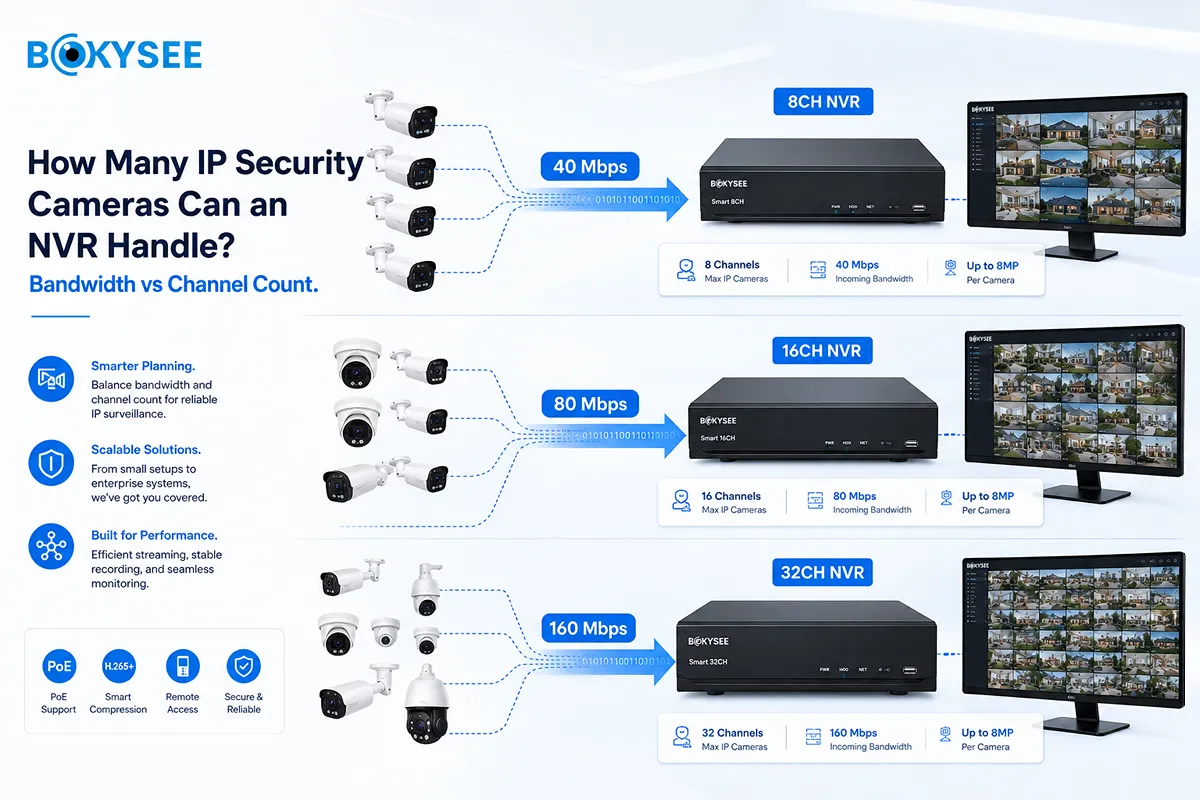
Quick Answer: How Many IP Security Cameras Can One NVR Support?
An NVR can support only as many IP security cameras as its channel count, incoming bandwidth, recording capability, decoding capacity, outgoing bandwidth and network design allow. A 16-channel NVR may register sixteen cameras, but it may not record sixteen 8MP cameras at maximum bitrate and display every main stream at full resolution simultaneously.
The correct calculation starts with camera quantity and bitrate, then checks NVR bandwidth, decoding, PoE ports, storage and remote viewing. Buyers can compare Bokysee NVR and video recorder solutions con el Bokysee IP security camera range and select them as one system.
How Does NVR Channel Count Limit IP Security Camera Capacity?
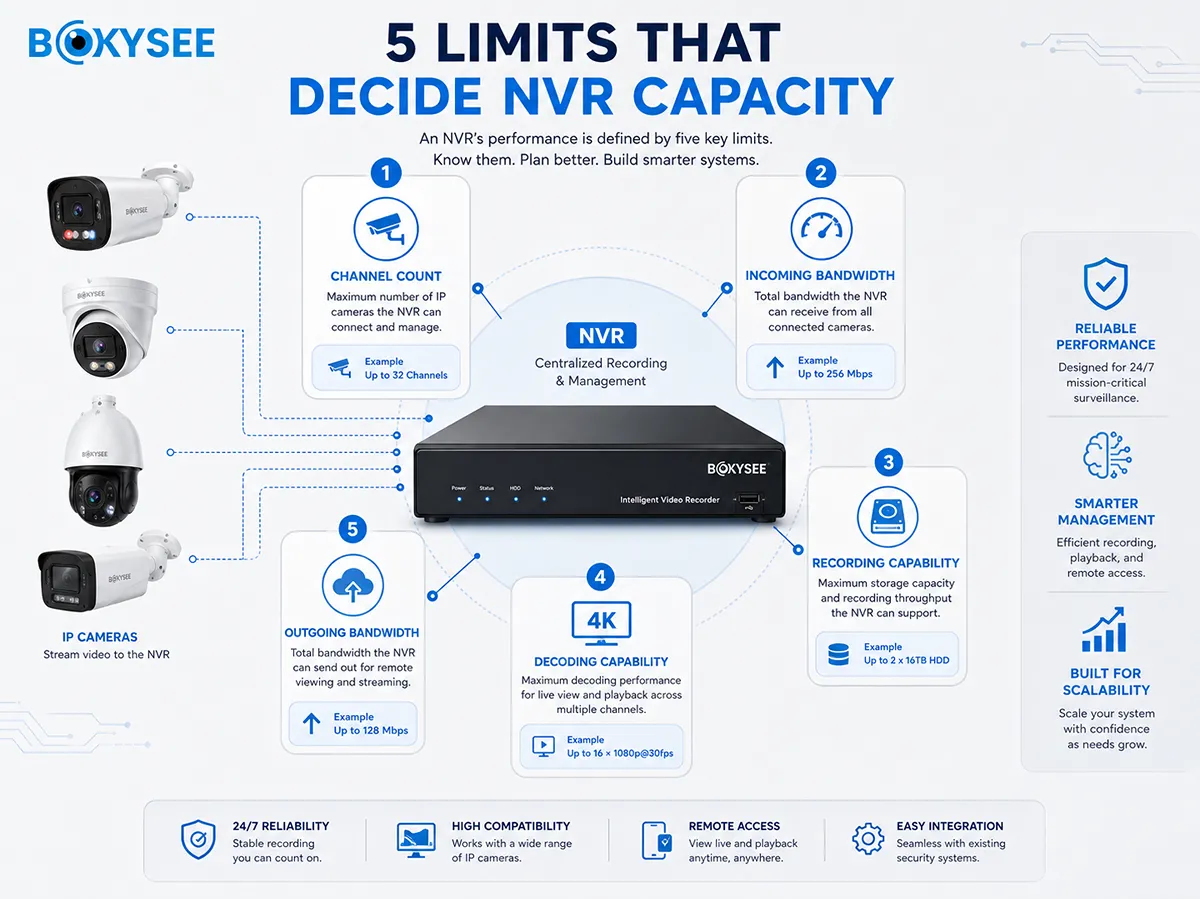
Channel count is the first limit. A 4-channel NVR generally manages four camera channels, an 8-channel model manages eight, and a 16-channel model manages sixteen. However, channel count only tells you how many camera identities the recorder can register. It does not prove that every channel can record at the maximum resolution, frame rate and bitrate.
A channel is also not always equal to one physical PoE port. A 16-channel NVR may include eight PoE ports and accept eight additional network cameras through an external PoE switch. A complete specification should therefore list:
· Maximum network camera channels
· Number of integrated PoE ports
· Incoming and outgoing bandwidth
· Maximum recording resolution
· Simultaneous decoding capability
· HDD bays and maximum HDD size
· Supported camera protocols and codecs
“16CH NVR” alone is not enough information for a project quotation.
How to Calculate NVR Incoming Bandwidth for IP Security Cameras
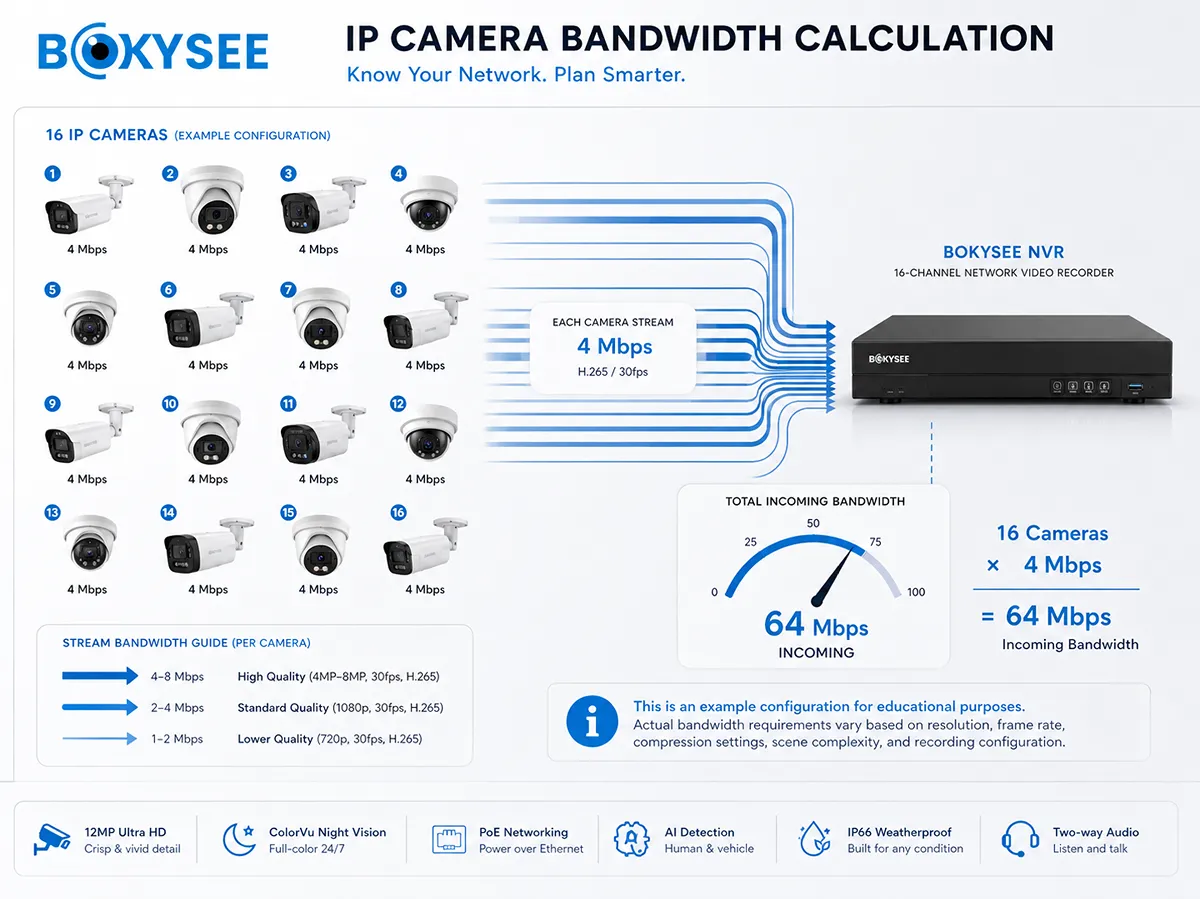
Incoming bandwidth is the total video data received from all cameras. Use this first calculation:
Total incoming bandwidth = number of cameras × configured main-stream bitrate
Add margin for audio, metadata, network overhead and variable-bitrate peaks. A system should not operate continuously at the recorder’s absolute published limit.
Example: Sixteen 5MP IP security cameras
If each camera records at 4 Mbps:
16 × 4 Mbps = 64 Mbps
An 80 Mbps NVR leaves only 16 Mbps of headroom. Night noise, movement, audio or VBR peaks may increase traffic, so a higher-bandwidth model could be safer.
Example: Sixteen 8MP IP security cameras
If each camera records at 8 Mbps:
16 × 8 Mbps = 128 Mbps
A 16-channel NVR with 80 Mbps incoming bandwidth would not be suitable at those settings. Choose a higher-bandwidth recorder or reduce bitrate, FPS or recording resolution after confirming that evidence quality remains acceptable.
NVR Bandwidth Table for 2MP, 4MP, 5MP and 8MP IP Security Cameras
These are planning examples, not universal values. Actual bitrate depends on codec, FPS, scene movement, night noise, WDR, audio and image-quality settings.
| Camera Configuration | Example Bitrate per Camera | 8 Cameras | 16 Cameras | 32 Cameras |
| 2MP, moderate FPS, H.265 | 2 Mbps | 16 Mbps | 32 Mbps | 64 Mbps |
| 4MP, moderate FPS, H.265 | 3 Mbps | 24 Mbps | 48 Mbps | 96 Mbps |
| 5MP, moderate FPS, H.265 | 4 Mbps | 32 Mbps | 64 Mbps | 128 Mbps |
| 8MP, moderate FPS, H.265 | 6 Mbps | 48 Mbps | 96 Mbps | 192 Mbps |
| 8MP, higher-motion scene | 8 Mbps | 64 Mbps | 128 Mbps | 256 Mbps |
Two 8MP cameras can create very different traffic. A quiet corridor at 12-15 fps needs less data than a vehicle entrance at 25 fps with WDR and audio. The Bokysee CCTV bitrate optimization guide explains how H.265, FPS, VBR and sub streams affect network and storage demand.
Why NVR Recording Capacity and NVR Decoding Capacity Are Different
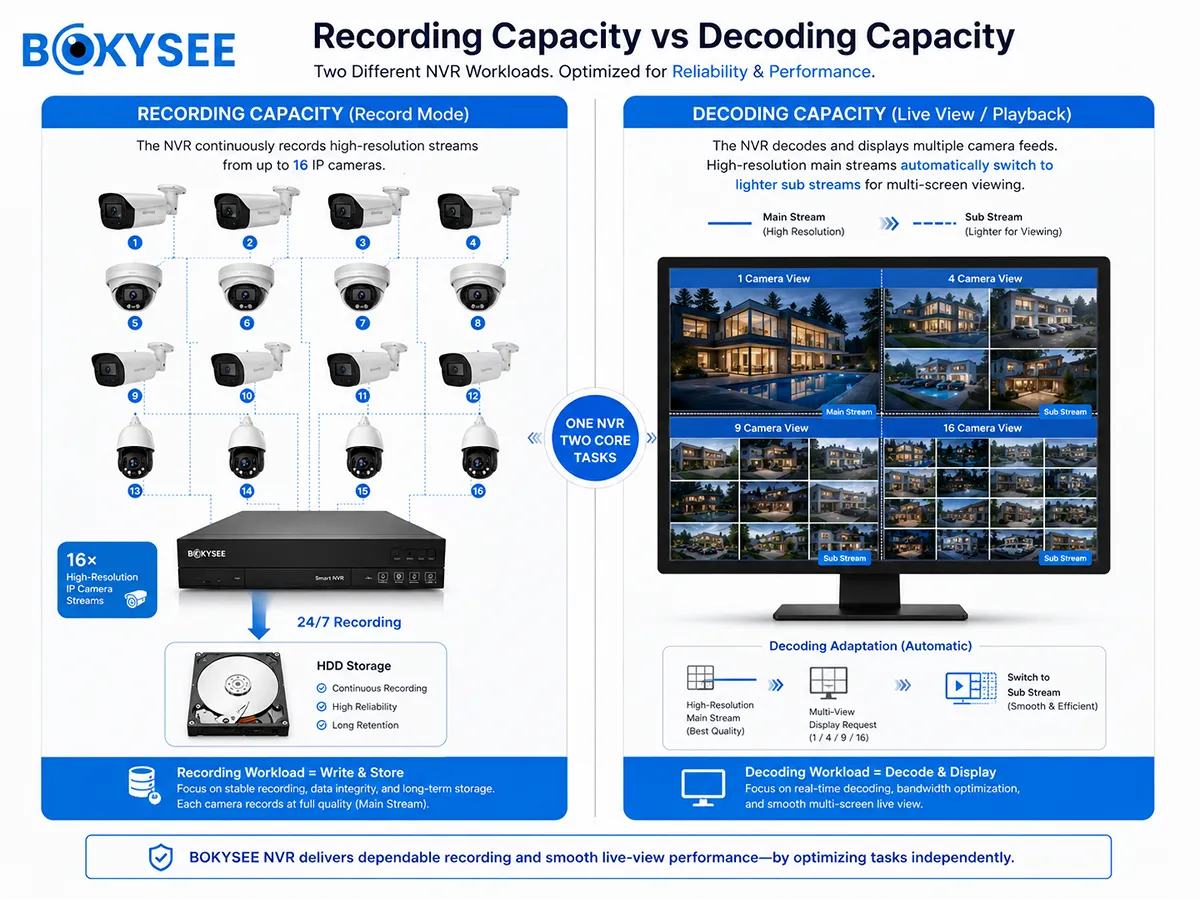
Recording capacity describes how many streams an NVR can receive and save. Decoding capacity describes how many streams it can display or play back at a particular resolution.
A recorder may record sixteen 8MP main streams but decode only one or four 8MP streams simultaneously. In a sixteen-camera split screen, it may display sub streams. When the user opens one channel full-screen, it switches to the main stream.
This protects recording quality while reducing processor load. Request a decoding specification that states how many 8MP, 4MP and 1080p streams can be displayed or played back simultaneously. Then test live view, playback and remote access.
Can a 16-Channel NVR Record Sixteen 8MP IP Security Cameras?
Yes, when all of the following are true:
1. The NVR supports sixteen network camera channels.
2. It supports 8MP recording on the required channels.
3. Incoming bandwidth exceeds the combined camera bitrate with margin.
4. The NVR supports the camera codec and stream profile.
5. HDD capacity meets the retention period.
6. Decoding capacity meets local display and playback needs.
7. Outgoing bandwidth supports remote users.
8. PoE ports or an external switch support the physical connections.
El Bokysee 8MP PoE IP security camera NVR kit illustrates how camera resolution, PoE power and recording can be matched in one package. Larger projects should follow the same system-level method.
How Do PoE Ports Affect the Number of IP Security Cameras on an NVR?
A PoE NVR includes an internal switch that powers cameras through Ethernet. This simplifies installation but adds limits:
· Physical PoE port count
· Total PoE power budget
· Maximum power per port
· Internal switch bandwidth
· Cable distance and quality
A 16-channel NVR with eight PoE ports can often support eight directly connected cameras plus additional cameras through an external switch. The cameras must be reachable on the network, and the total channel count and bitrate must remain within NVR limits.
Do not connect a PoE+ PTZ camera to a standard PoE port without confirming the power requirement. Video bandwidth and PoE power must be calculated separately.
How to Calculate NVR Storage After Calculating IP Camera Bandwidth
Bandwidth and storage are two sides of the same calculation. A useful estimate is:
Storage per day in GB ≈ total bitrate in Mbps × 10.8
This assumes continuous recording and does not include file-system overhead, reserved disk space or smart-recording variation.
Example: Sixteen cameras at 4 Mbps each
Total bitrate:
16 × 4 Mbps = 64 Mbps
Approximate daily storage:
64 × 10.8 = 691.2 GB per day
Approximate 30-day raw requirement:
691.2 × 30 = 20,736 GB, or about 20.7 TB
The final design should account for usable HDD capacity, recording schedule, event recording and retention margin. See the Bokysee NVR storage planning guide for a deeper explanation.
The official ITU-T H.265 recommendation defines High Efficiency Video Coding. H.265 can improve compression efficiency, but actual savings vary by scene, encoder and quality target.
Why Does an NVR Show “Bandwidth Exceeded” or “Resource Insufficient”?
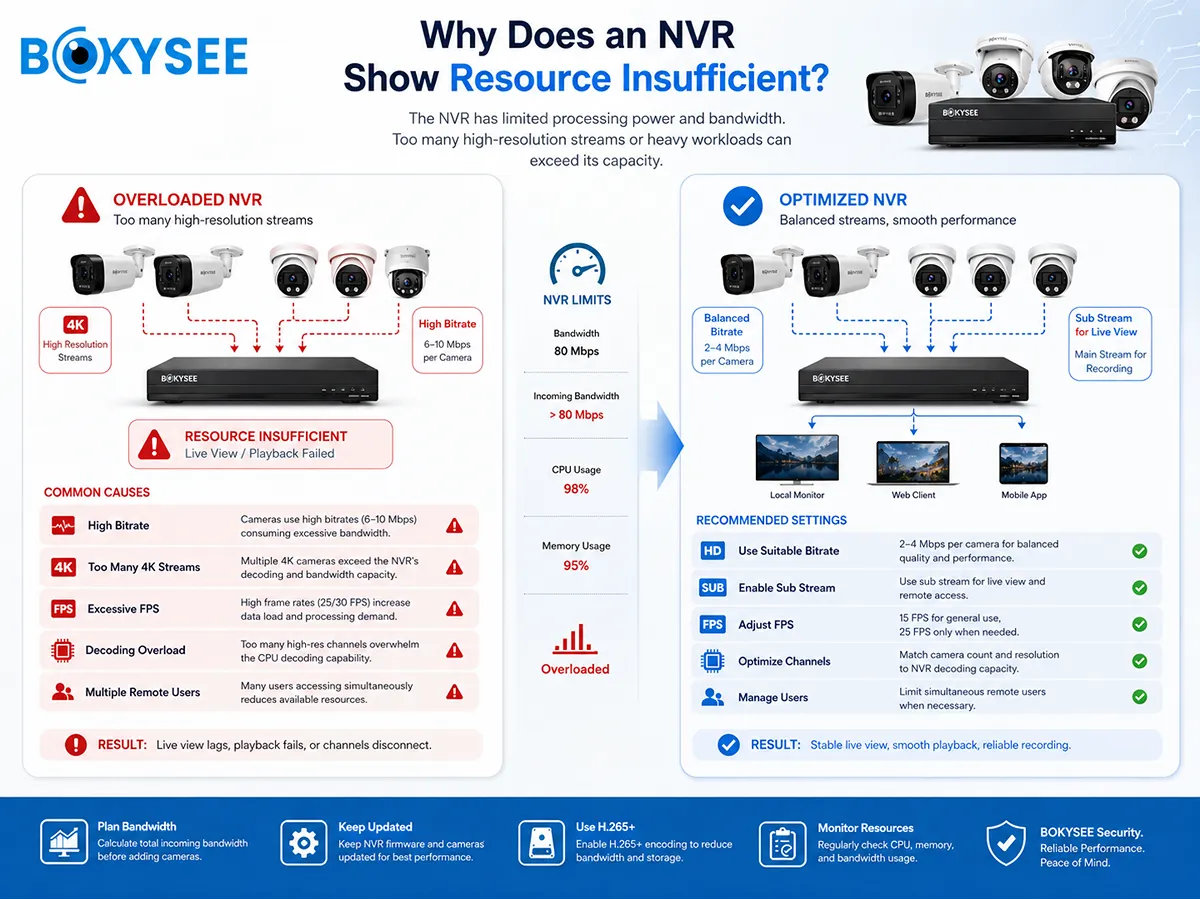
Common causes include:
· Combined camera bitrate exceeds incoming bandwidth
· Too many high-resolution streams are displayed
· FPS is unnecessarily high
· H.265 decoding load exceeds processor capacity
· Main and sub streams are misconfigured
· Too many remote users are connected
· AI functions add processing load
· Firmware or stream negotiation is unstable
Check total incoming bitrate first, then use sub streams for multi-screen view and review codec, FPS, remote users and AI load. The NVR can still record the main stream while displaying a lower-bandwidth sub stream.
NVR Selection Checklist for IP Security Camera Projects
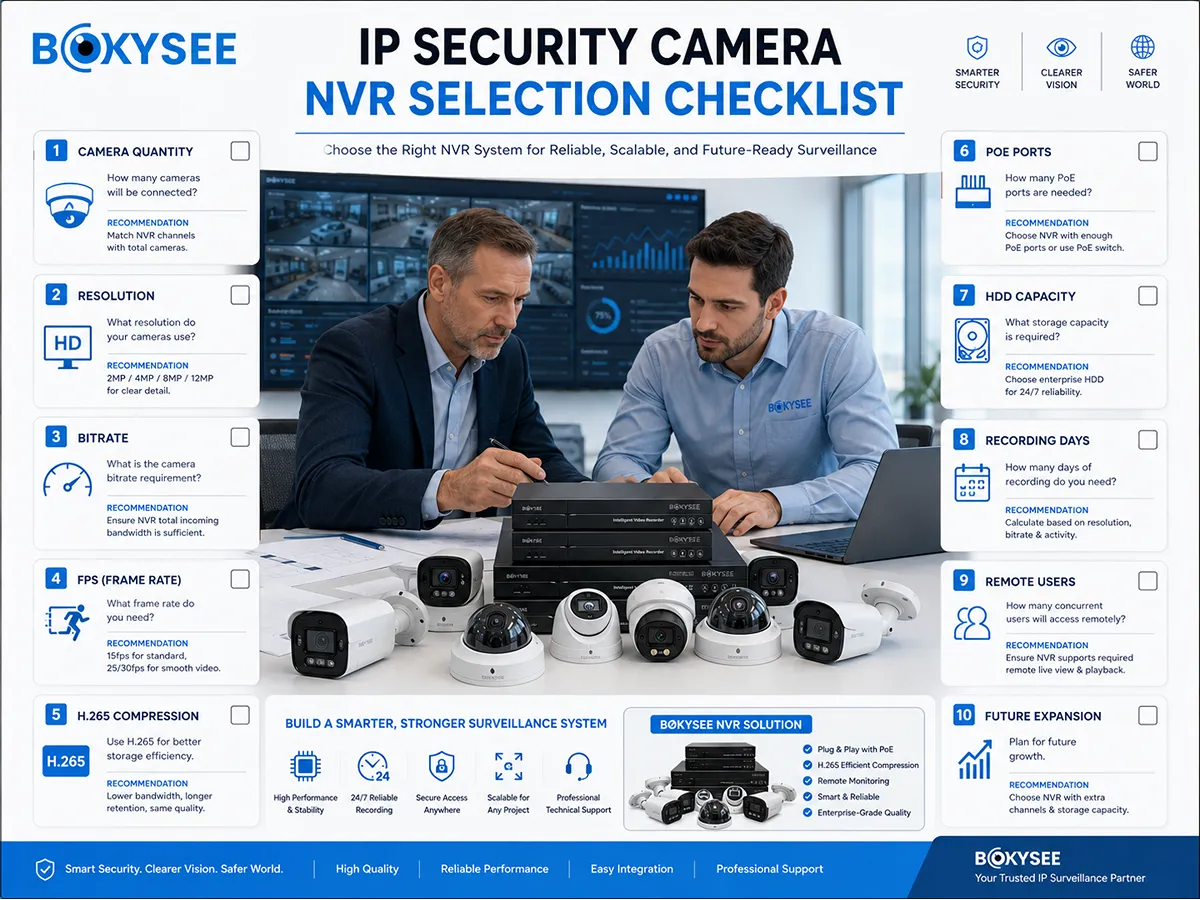
| Project Input | Example |
| Camera quantity | 24 cameras |
| Camera resolution | 5MP fixed and 8MP PTZ |
| Main-stream bitrate | 3-8 Mbps per camera |
| Velocidad de cuadros | 15 fps general, 25 fps entrance |
| Codec | H.265 preferred, H.264 fallback |
| Modo de grabación | Continuous plus event marking |
| Retention period | 30 days |
| Remote users | Three simultaneous users |
| Local display | 16-channel split screen |
| PoE requirement | 16 built-in ports plus external switch |
| HDD bays | Two or four SATA bays |
| Expansion | 20-25% spare channels and bandwidth |
Use these inputs to choose channel count, bandwidth, decoding, outgoing capacity, PoE and storage. Review Bokysee 4K PoE NVR options and request a matched system rather than selecting only by channel number.
NVR Capacity FAQ for IP Security Camera Buyers
Can an 8-channel NVR support eight 8MP IP security cameras?
Yes, if it supports 8MP recording and enough incoming bandwidth. Decoding and storage must also be checked.
Does H.265 allow an NVR to support more IP security cameras?
It may reduce bitrate for a similar quality target, freeing bandwidth and storage. Results depend on the encoder and scene.
Can I add cameras through an external PoE switch?
Yes, when the NVR supports the total channels and bandwidth and the cameras are reachable on the network.
Why is live view blurry while playback is clear?
The NVR is probably displaying the sub stream while recording the higher-quality main stream.
Should an NVR operate at its maximum incoming bandwidth?
No. Leave margin for peaks, audio, metadata, night noise, remote access and future expansion.
Final Recommendation: Match NVR Bandwidth to the Real IP Security Camera Configuration
The number printed on an NVR is only the beginning. Reliable projects calculate combined bitrate, confirm recording and decoding, plan PoE connections, estimate storage and leave expansion capacity.
Send Bokysee the camera quantity, resolution, bitrate, FPS, recording days and remote-viewing requirement to receive a matched IP security camera and NVR system for sample testing and quotation.











 Spanish
  English
  Russian